Within an hour of sunset, I took these photographs along Piney Woods Church Road, near its intersection with Rico Road. The fern present in every photograph is an ebony spleenwort (Asplenium platyneuron).

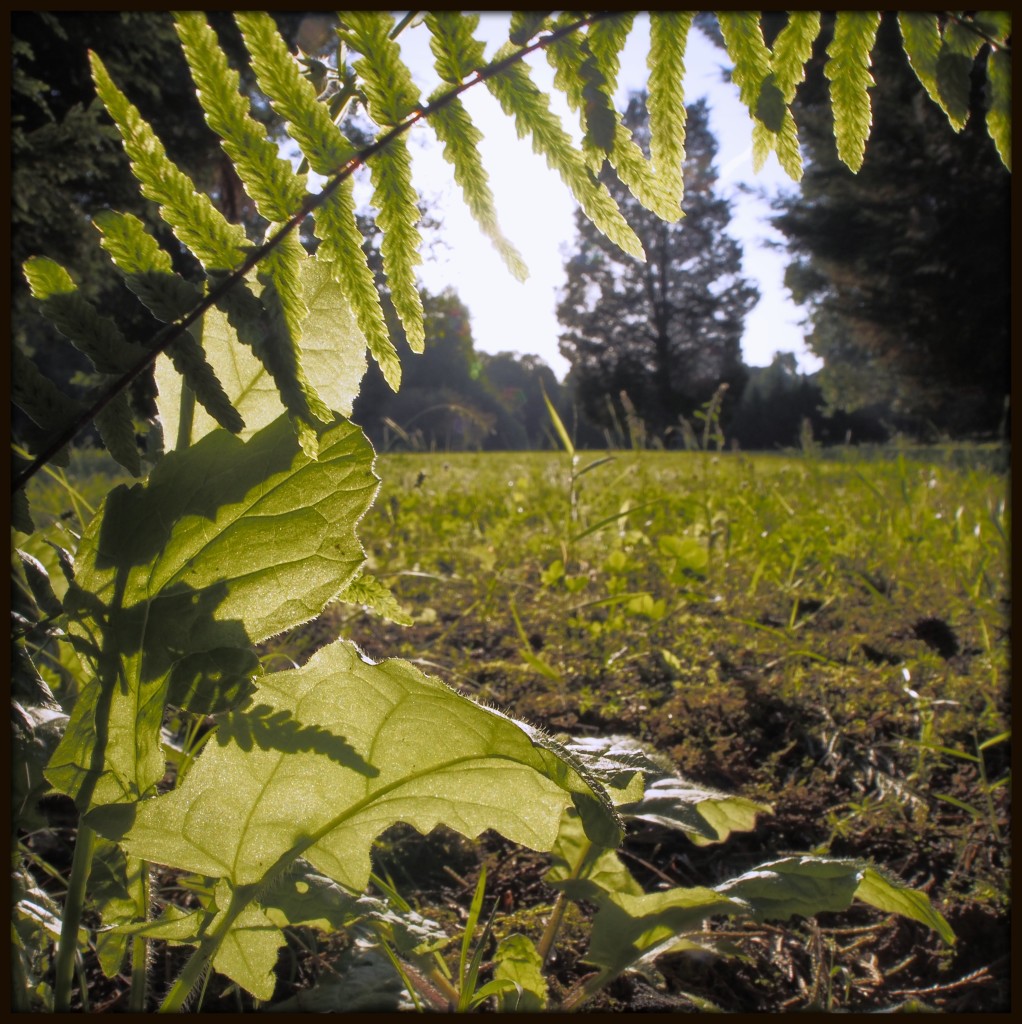
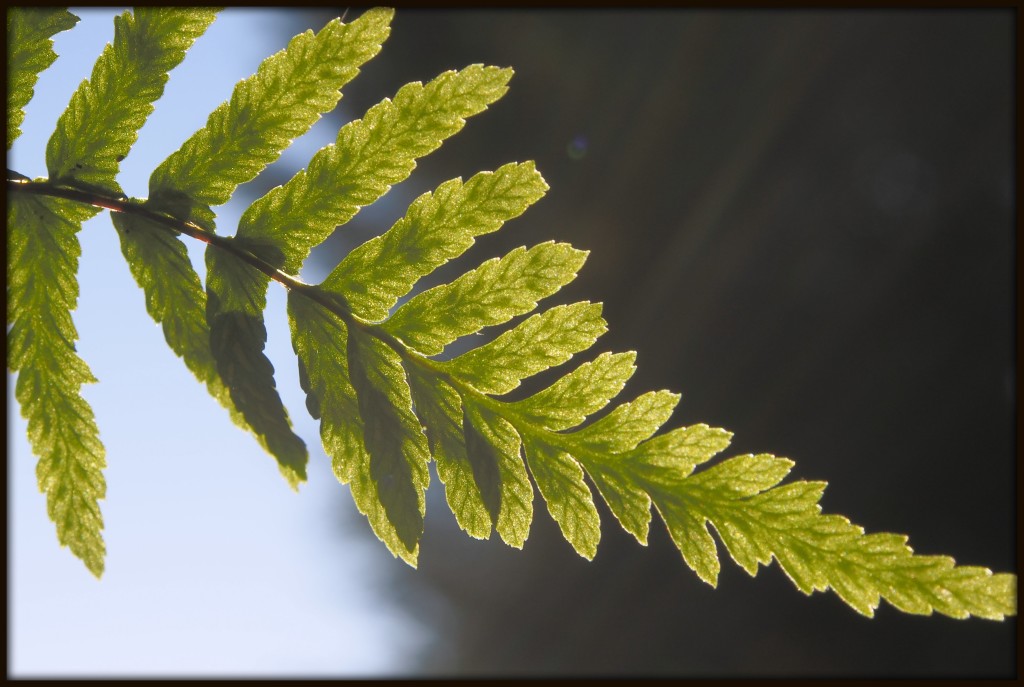
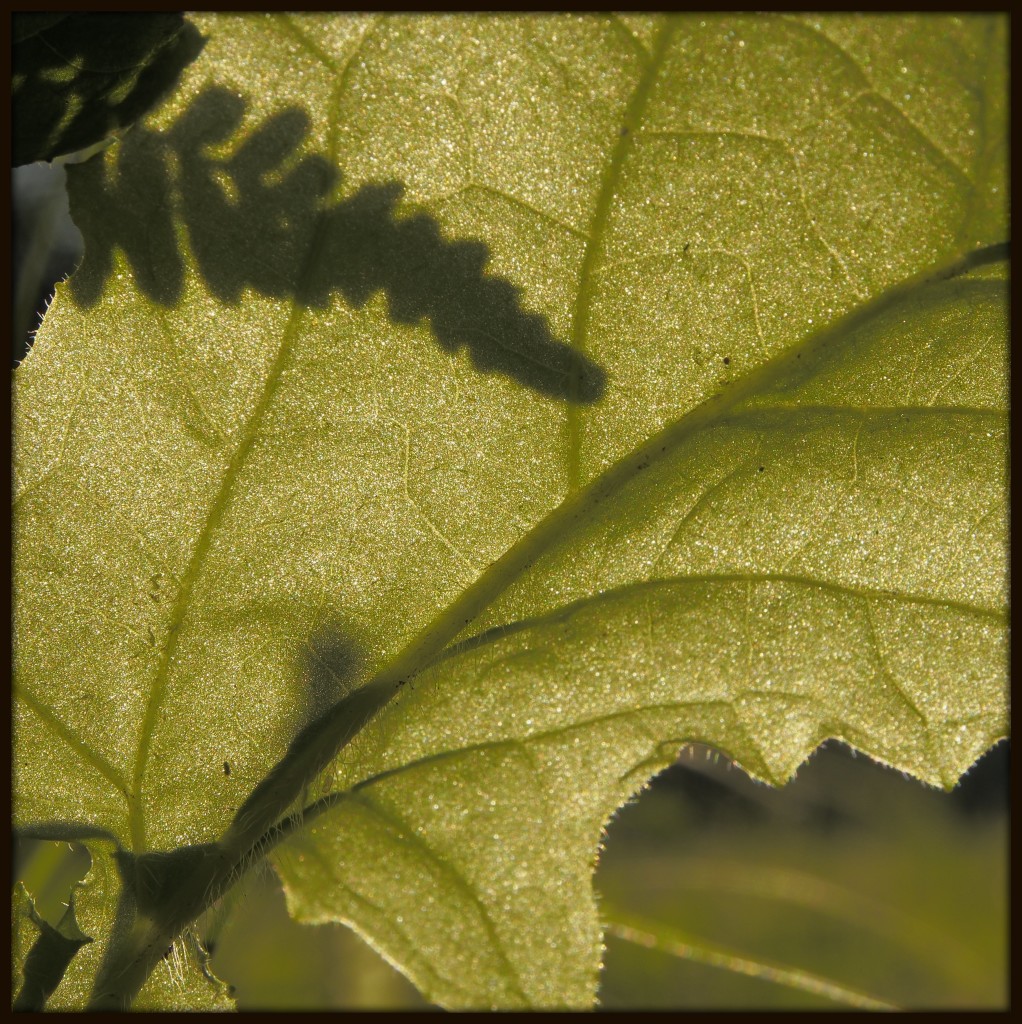
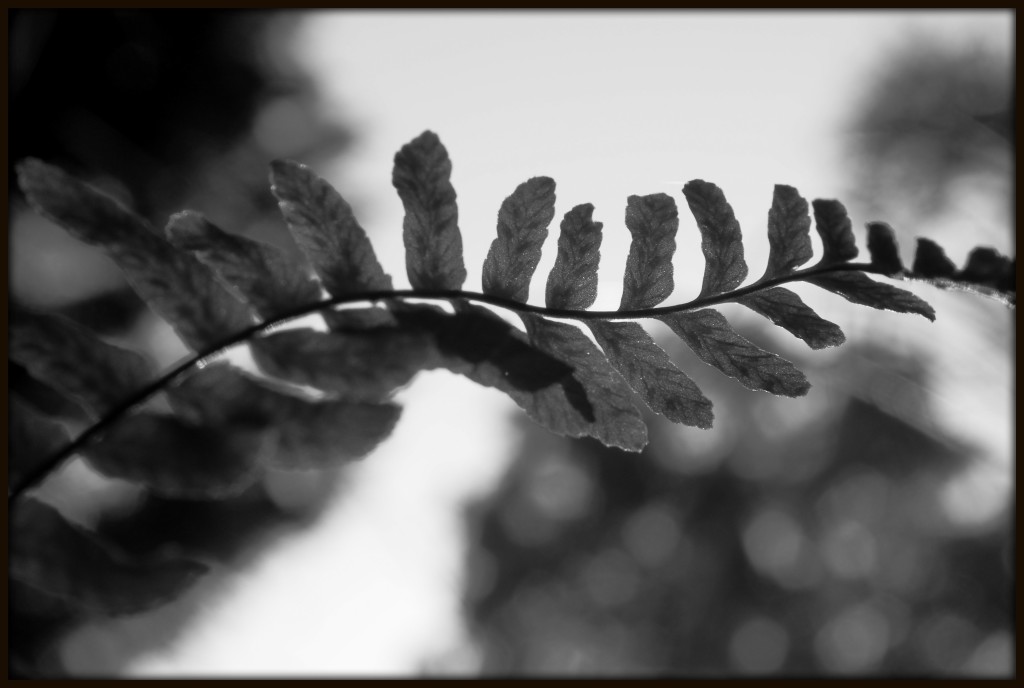

Within an hour of sunset, I took these photographs along Piney Woods Church Road, near its intersection with Rico Road. The fern present in every photograph is an ebony spleenwort (Asplenium platyneuron).
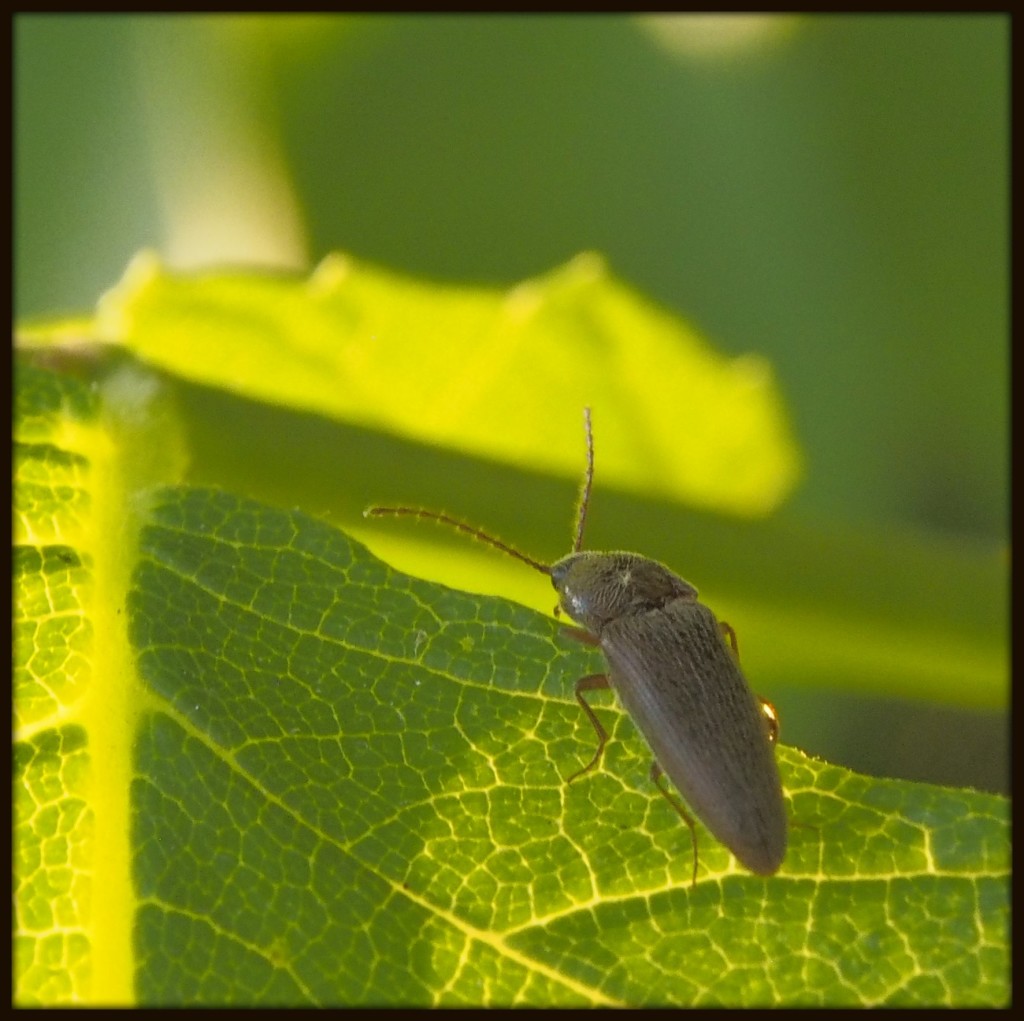
In this photograph from my evening walk along Piney Woods Church Road, an unidentified brown beetle pauses at the edge of a leaf.
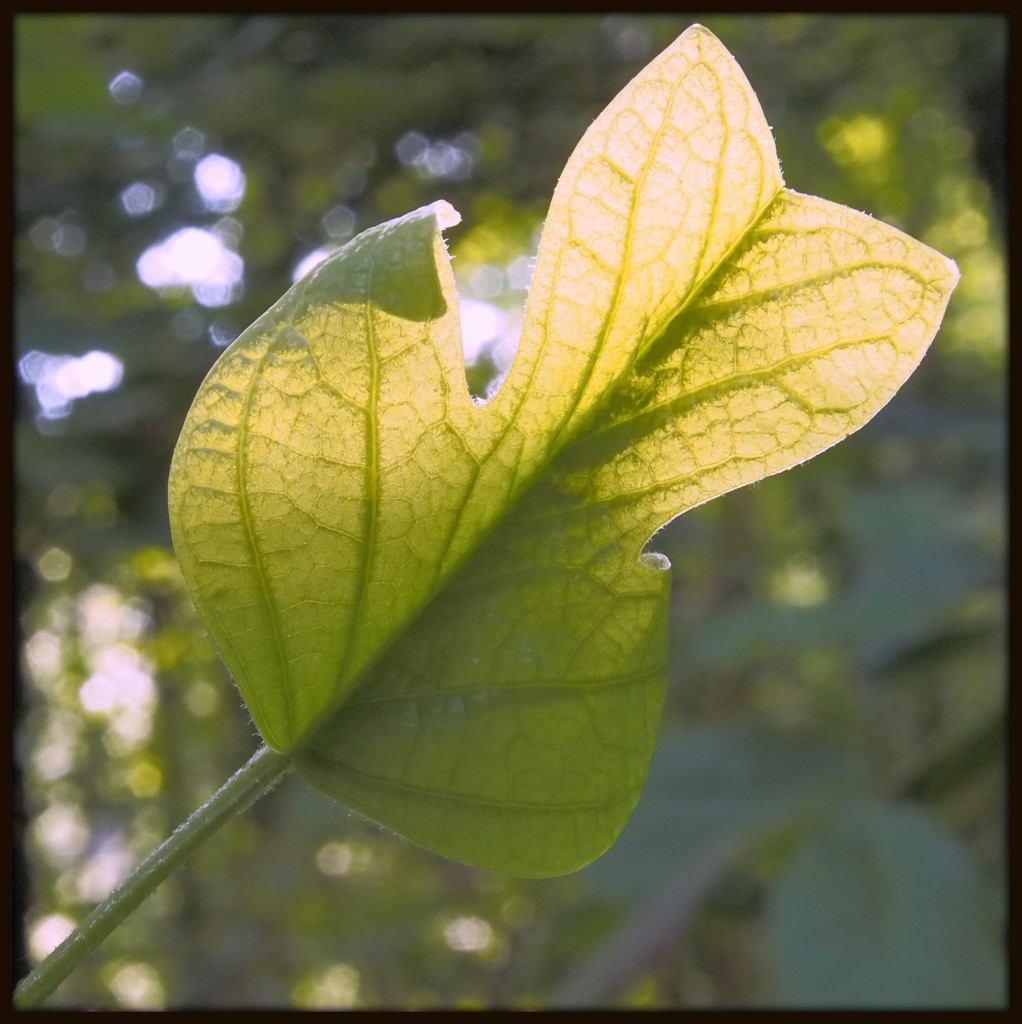
This morning I set out down Piney Woods Church Road as usual, in search of an image for Day 140. I knew it would be practically impossible to match yesterday’s photographs of a pair of mating silkmoths. I settled, instead, for yet another tulip poplar leaf, illumined by the mid-morning sun. There is so much beauty in even the most commonplace expressions of nature.
On my Piney Woods Church Road walk today, as I mentioned in an earlier post, I discovered that a Saturniid moth cocoon that I had been watching for ages (and photographed earlier this year) had opened, and a lovely female tulip-tree silkmoth (Callosamia angulifera) was resting beside it, occasionally fanning her wings. Of course, I had forgotten to put my memory card back into the camera, so I raced home, added the memory card, and drove back in time to take these photographs.
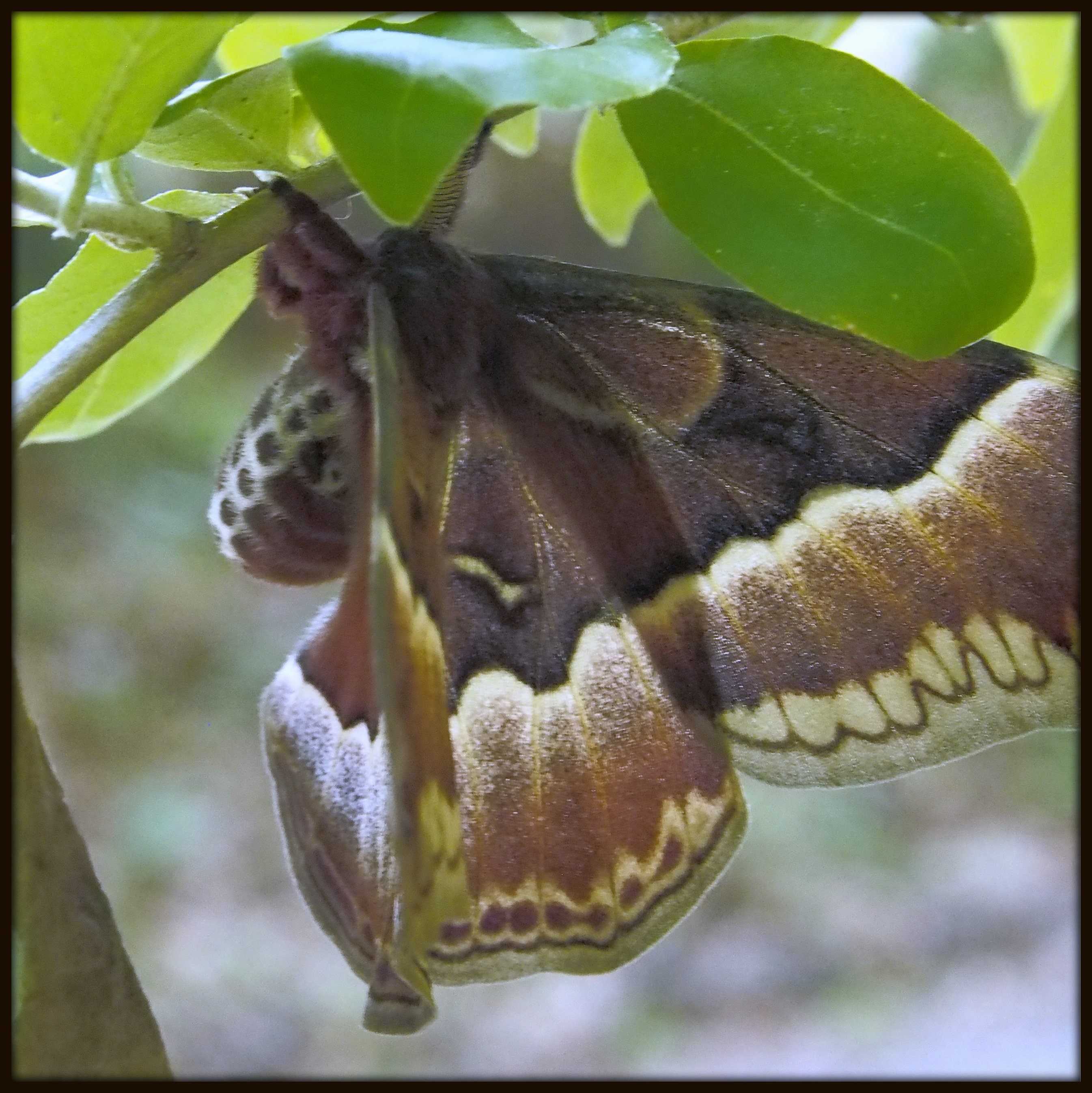
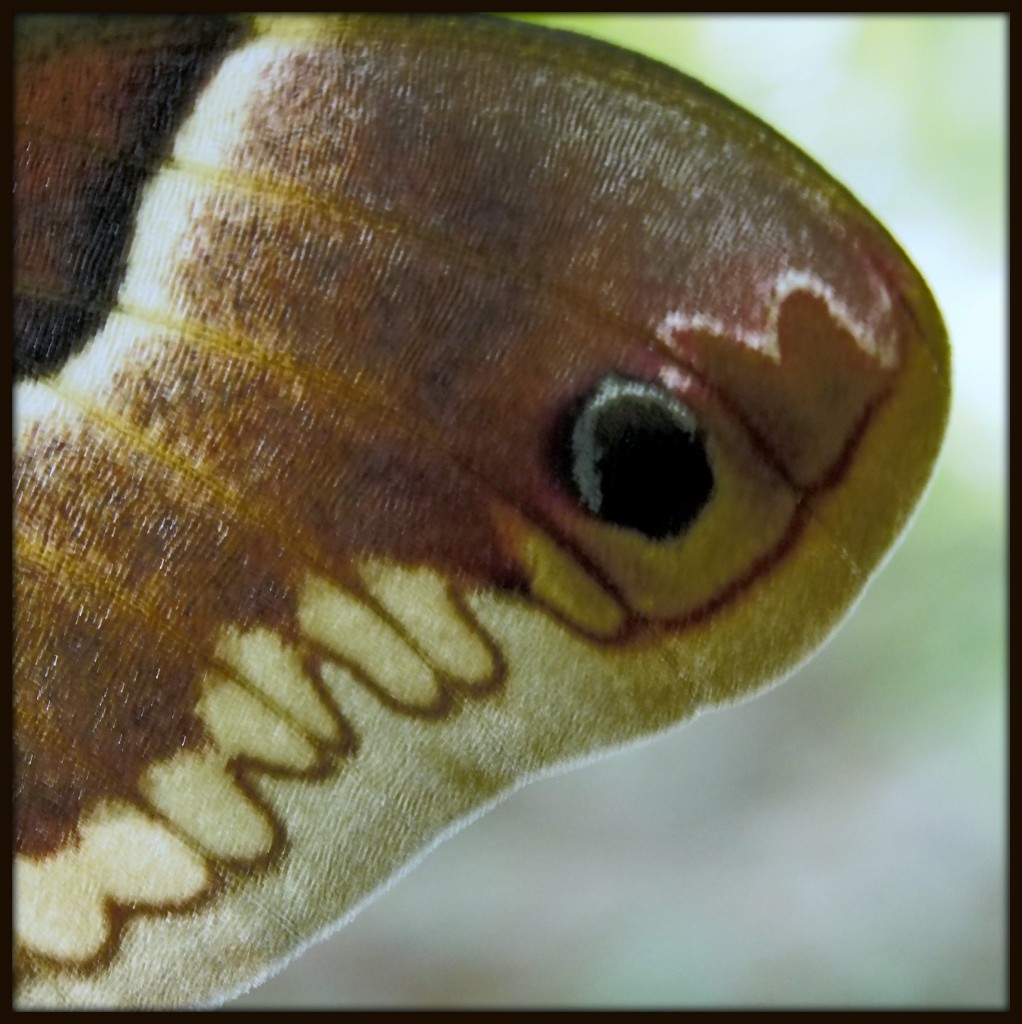
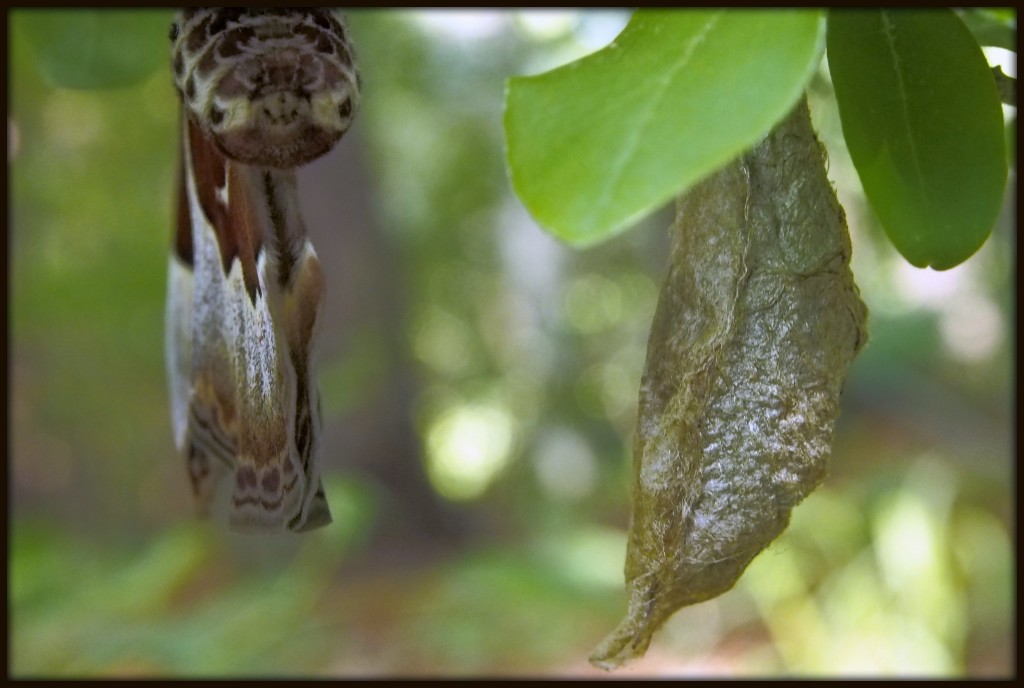
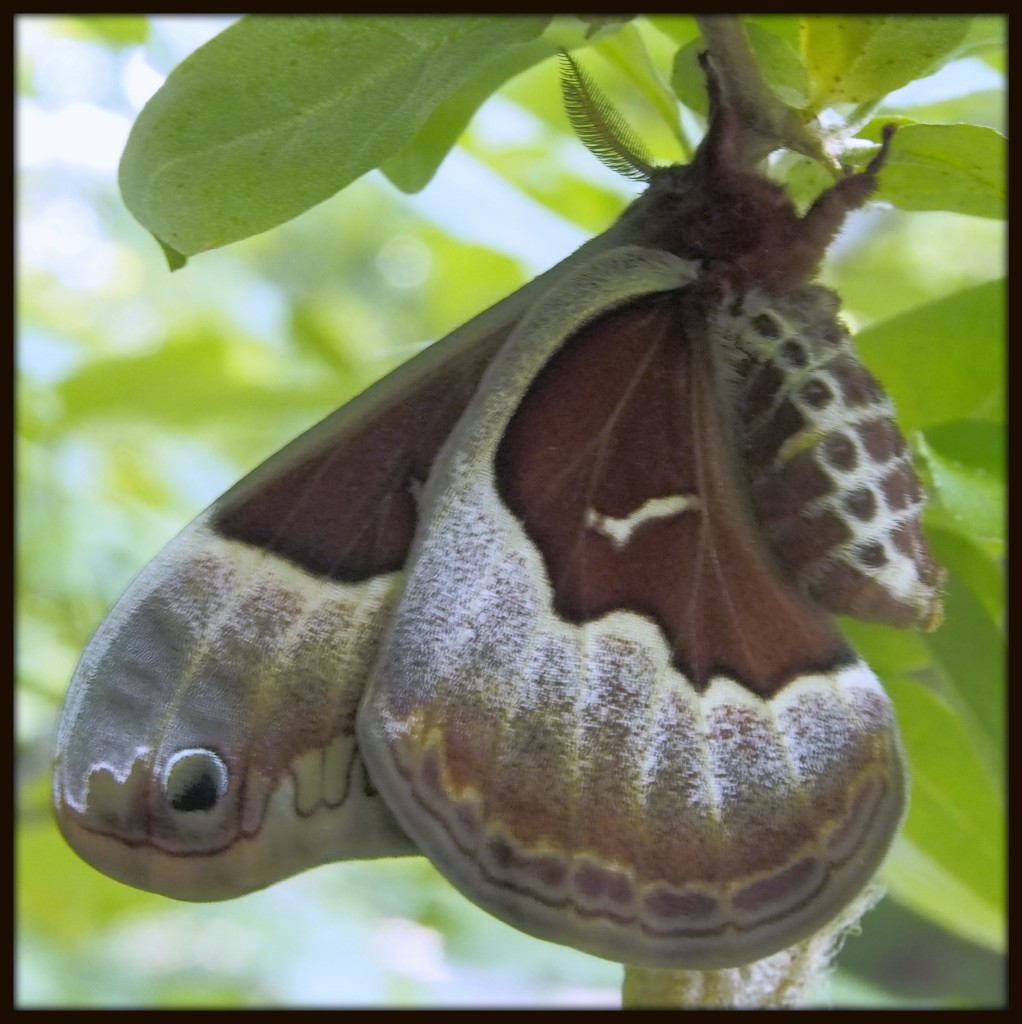
The day’s wonders were not over yet, though. I returned home, did a few chores, and left with my wife and our four dogs on our evening walk. I was excited to share my discovery with Valerie. But instead of just one moth, I found two moths mating! While she was resting there, the female tulip-tree silkmoth most likely released a pheromone to attract male moths in the area. The result are these photographs below. I had never witnessed moths mating before this. After mating, the male will die, and the female will fly off to lay her eggs on an inviting food source, such as the leaves of a tulip poplar tree (though black cherry and sassafras will work fine, too).
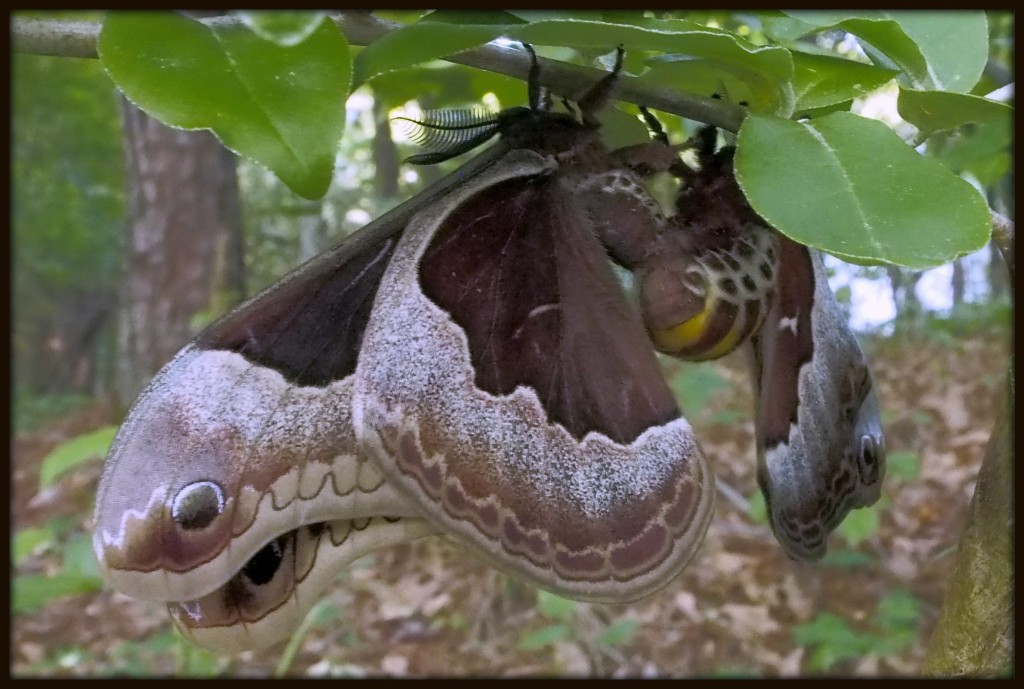
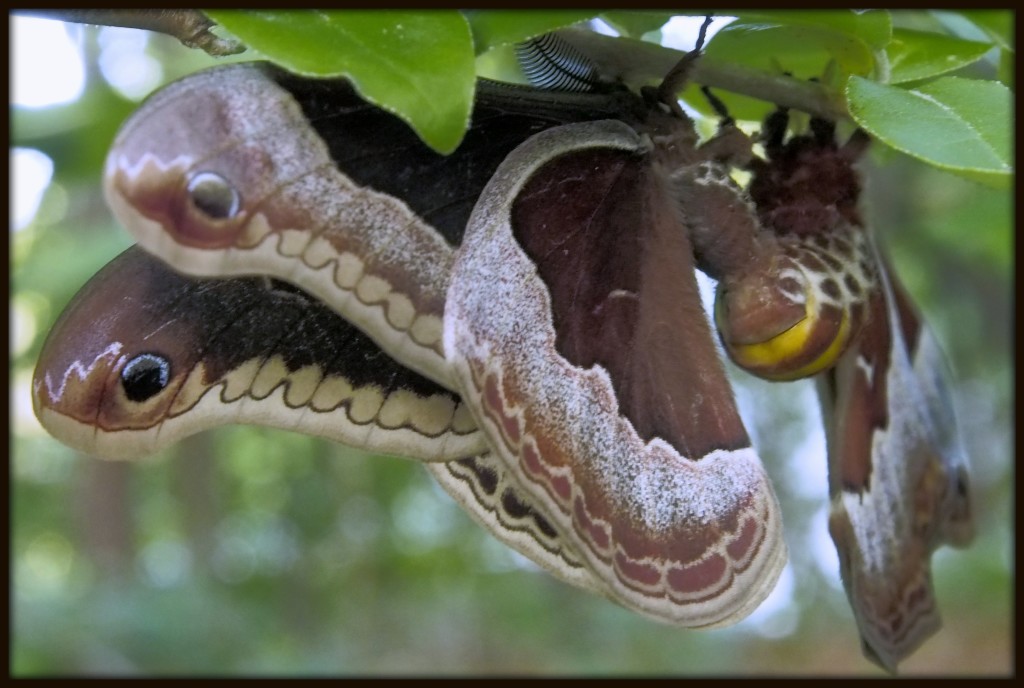
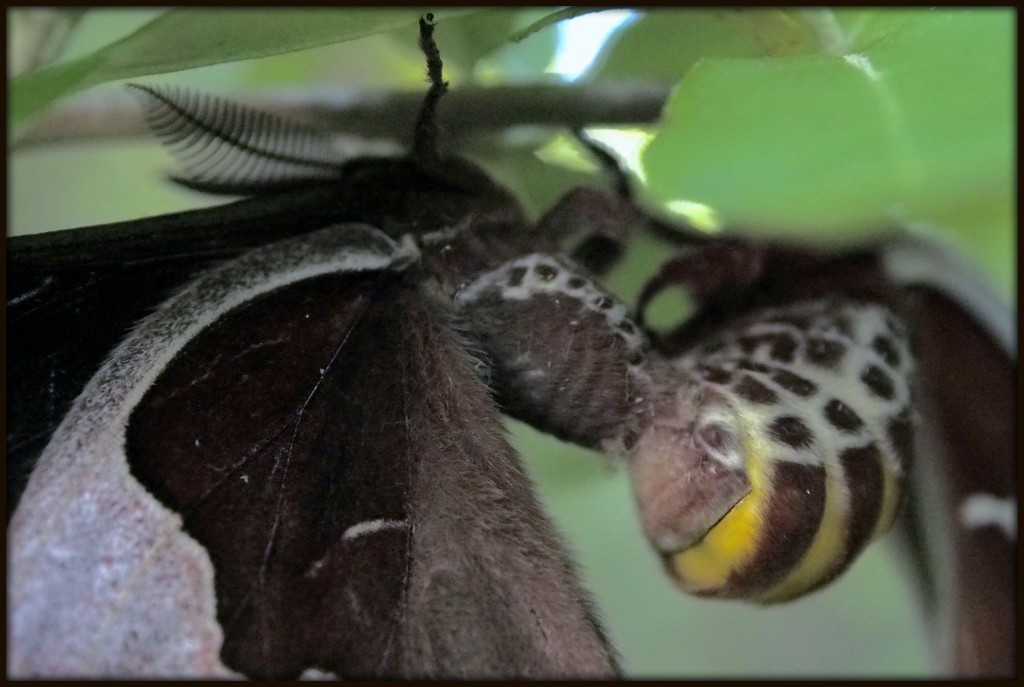
I returned to the same privet branch the next morning, May 20th, and both moths were gone. To my surprise, I inspected the cocoon that still remained attached strongly to the branch, and it was unopened. By some coincidence of nature (perhaps because that branch is an excellent piece of moth real estate), the tulip-poplar silkmoth I photographed yesterday just happened to choose the same location as the cocoon from which to broadcast her pheromones. I am left still waiting for another emergence to happen.
On my walk late this afternoon, I was startled and delighted to discover that the Saturniid moth whose cocoon I photographed earlier this year had chosen this very day to emerge. It was a female tulip-tree silkmoth (Callosamia angulifera). What a beautiful creature, and how fortunate I was to be passing by — and to notice this moth — at the time of her emergence.
As an addendum, I discovered the next day that I was mistaken — it was a different moth from the one in the cocoon! The cocoon remains intact as of 23 May, and I continue to await the emergence of yet another moth.
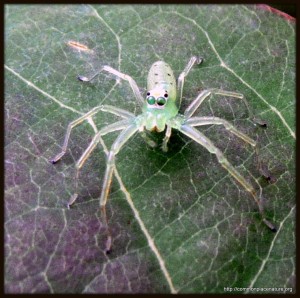
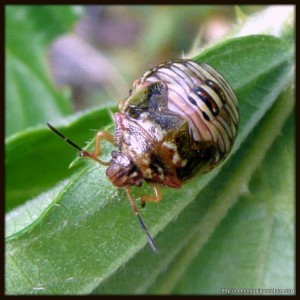
Last month, before the current vicious hot spell and drought seized hold of Georgia, this writer spent many hours at work in the gardens around his home. “Garden” is not really the appropriate term; “weed haven” is far closer to the truth, or possibly “sweet gum seedling nursery, blackberry cane patch, and dog fennel maintenance area”. There is an ongoing battle, never to be won, between the commonplace and often invasive plants with little ecological value and the plants this author prefers to find growing nearby: native plants that are attractive to pollinators such as butterflies and hummingbirds, yet unpalatable to the deer. It was in the midst of such a skirmish that the author encountered the two small creatures that are the theme of this article: one a bug, the other a spider. Despite the many small invertebrates this writer has found (and in many cases written about) here in Georgia (and often in and around his property), both of these were first encounters for him. And both of them were, in this writer’s opinion, beautiful.
The bug was crawling slowly about on a stalk of blackberry cane. What was striking about it was the patterning on its back, which was somewhat evocative of Zuni art of the Southwest. For example, compare the photograph of the insect that accompanies this article with this piece of jewelry. Although smaller than my thumbnail, its intricate, colorful pattern was quite evident, even to the naked eye. But what was it?
Alas, it turned out to be a much-maligned insect, one responsible for extensive crop damage in the Southeast. The insect lays its barrel-shaped egg cases on the surfaces of leaves. The eggs hatch, and for the next several weeks, the insect is in its nymph form — small, colorful, and unable to fly. After molting five times, it takes on more frequently photographed adult form by which it is known: the Southern green stink bug, Nezara viridula. In Garden Insects of North America, the author, Whitney Cranshaw, offers no kind words about this aggressive herbivore. He writes that “it is considered an important pest of vegetables and field and orchard crops. Legumes and crucifers are particularly favored…. Feeding on buds and blossoms causes them to wither and die. Feeding punctures of fruit cause deformed growth, and seeds may be shriveled.” What of the insect’s appearance? Cranshaw observes simply that the adults are “dull green” while the nymphs are “pinkish but turn increasingly green with age.” After searching several websites and three different insect field guides, “pinkish [turning] green” was the closest to a description of the insect’s patterning that this author could find.
This is not to say that farmers ought to welcome Southern green stink bugs with open arms. The insects feed widely on agricultural crops, from peach and citrus trees to tomatoes, potatoes, cotton, and soybeans. But while field guides celebrate the ornate and colorful patterns on the wings of dragonflies and butterflies, they ignore Nezara viridula. Sure, it is an insect pest, and yes, it is a stink bug at that (insects known for “the copious amounts of foul-smelling liquid they discharge when disturbed,” as explained in the National Audubon Society Field Guide to Insects and Spiders). But all of that ought not to detract from its lovely patterning in the nymph form, a design which one might even refer to as living jewelry.
The spider was nearby, on a simple dark-green leaf edged in orange-red. (The plant in question has appeared in several places around the author’s backyard, but so far, its identity is a botanical mystery.) The spider was a quarter inch in size, with a translucent green body, long legs, black spots on the abdomen, and vertical chelicerae (hollow mouth parts for grasping food and injecting venom) – all characteristics indicating that it was a female magnolia green jumper (Lyssomanes viridis). The genus Lyssomanes is a tropical one, with eighty species that range from the Southern United States down through Central and South America. Motionless when I encountered her, she was waiting patiently for prey to pass by – midges, aphids, small wasps and flies, and perhaps even a green stink bug nymph. Like other jumping spiders, the magnolia green jumper does not build a web. Instead, it chases and pounces on its prey, bounding from leaf to leaf, leaving a slender silken line to mark its passage. As the name suggests, the magnolia green jumper frequents magnolia leaves, along with the leaves oaks and evergreen trees and shrubs in Southeast woodland, particularly in wetlands and on coastal barrier islands.
A particularly striking feature of the magnolia green jumper is its eyes, situated on an “eye mound” ringed with brownish-orange. Four of the eyes, along the sides of the mound, are simply large black dots. The other two are larger and much more prominent. They have dark half-moon-shaped retinas that swivel independently, a bit like they eyes of a chameleon. Like all jumping spiders, the magnolia green jumper has superb vision, which is necessary for an active daytime hunter. (Web-weaving spiders, by comparison, simply lie in wait for their prey and tend to have much poorer eyesight.)
While the magnolia jumping spider lacks the vivid color patterning of a butterfly, it has beauty of its own. It is a beauty of form: lithe, nimble, quick-moving, almost graceful. (For instance, in this video, watch as two magnolia green jumpers, meet, court and mate.) And there is something about the eyes, too. Look closely, and you can almost see the spider looking back at you. At such a moment, you may even be tempted to wonder: what does she think of us?
This article was originally published on June 10, 2011.
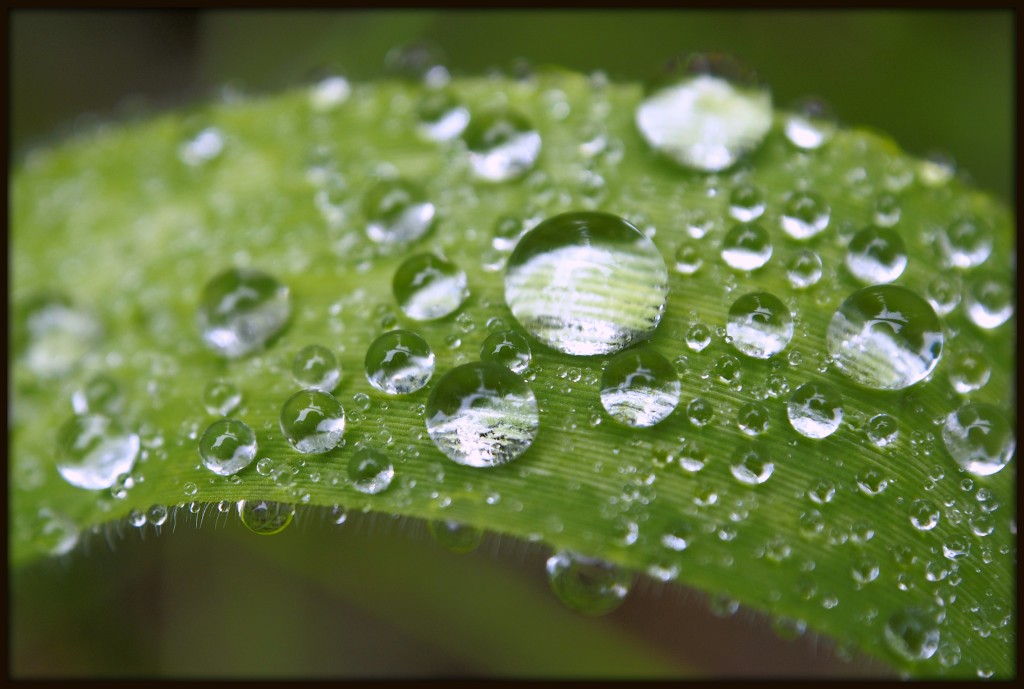
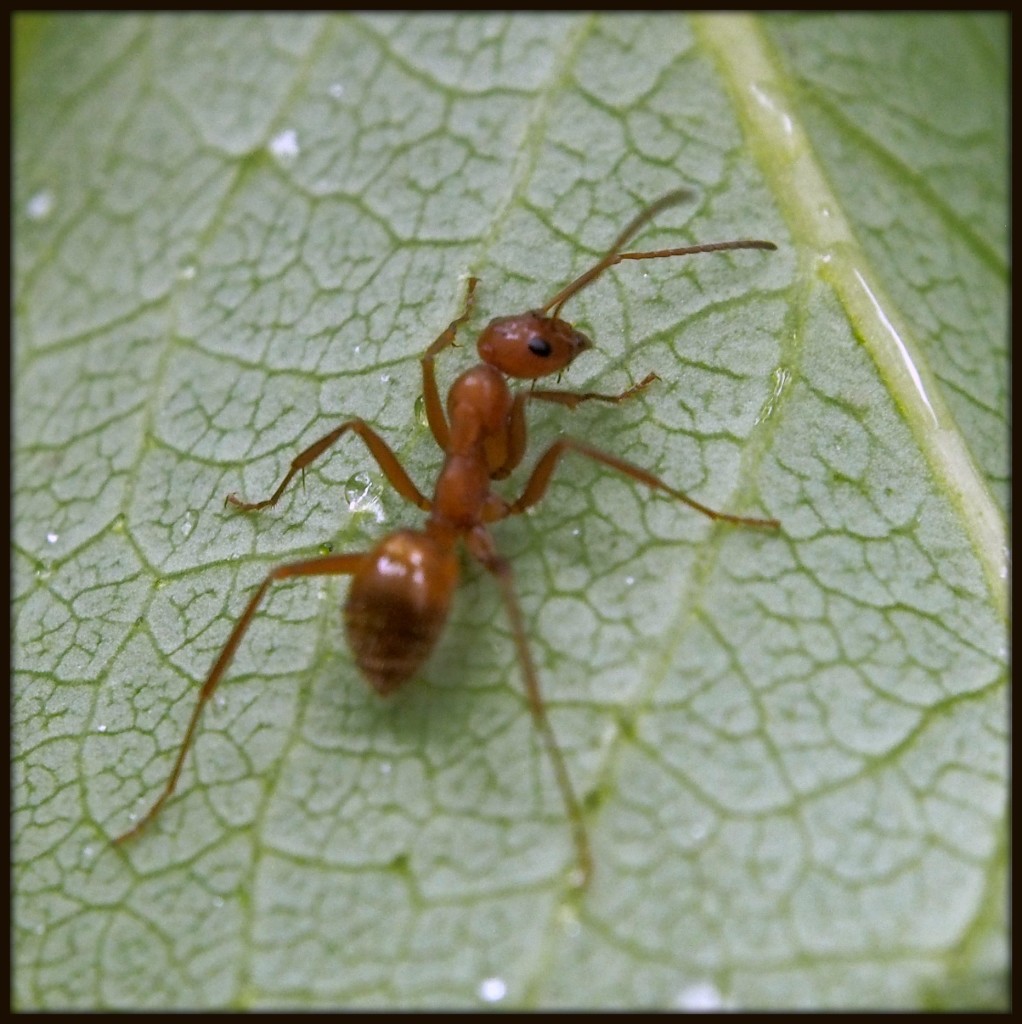
On a dripping, chilly afternoon I set out in search of the latest “news” along Piney Woods Church Road. As usual, I found all sorts of fascinating images of water droplets balanced on tree leaves or cradled by blades of grass. I also observed one intrepid red ant braving the elements on a Chinese privet. I spent several minutes photographing it, though most of the time it moved at a determined pace, preventing me from getting a picture in sharp focus. This one was an exception.
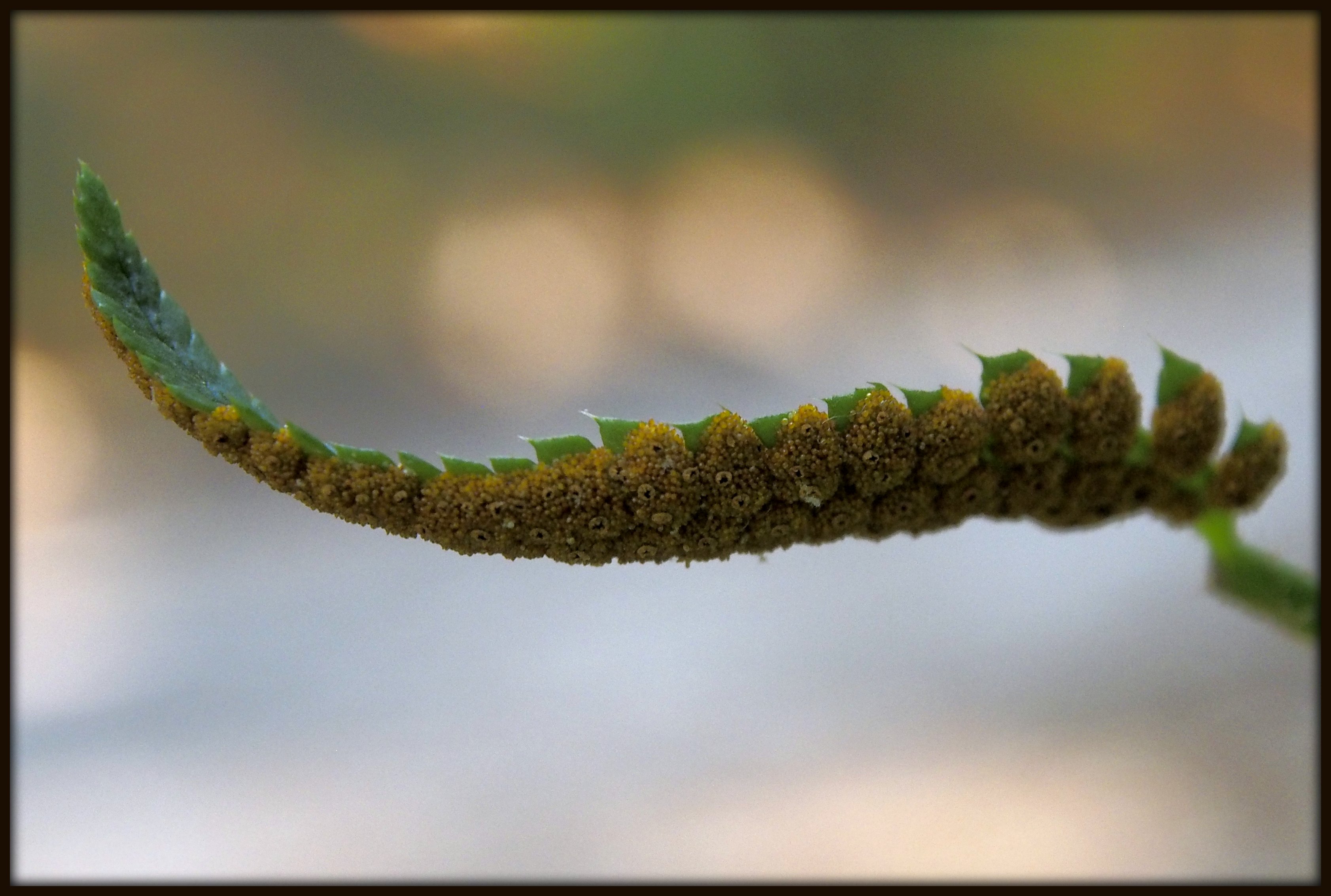
Today I dashed off to Piney Woods Church Road mid-afternoon, having returned from one hike (Line Creek Preserve in Peachtree City; photos from that walk will be posted tomorrow) and being about to leave for another one (Boundary Waters Park in Douglasville, where I hiked sans camera). I took few photographs; one feature that caught my eye was a Christmas fern (Polystichum acrostichoides) sporophyte frond covered with tiny brown dots, called sori (singular: sorus), which are clusters of spore-bearing structures called sporangia. Each sprangium, in turn, contains countless dust-like spores. Basically, there is a whole lot of reproduction going on here. No sex, though — that is reserved for a separate generation of fern plants, called gametophytes. Alternation of generations (from gametophyte to sporophyte and back to gametophyte) is characteristic of ferns, mosses, and their ilk.
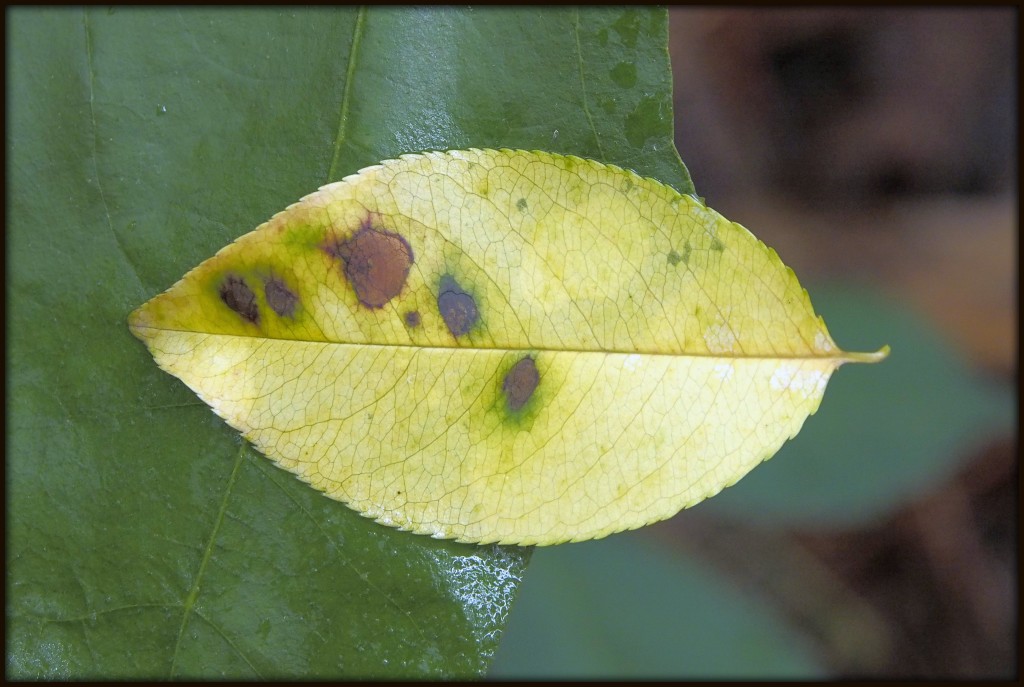
Late spring has come to Piney Woods Church Road, and everywhere I look I encounter shades of green. After last night’s rainfall, the green is vibrant, pulsing with life. It claims nearly every inch of my journey, apart from the road surface and cloud-filled sky. Splashes of other colors are rare and precious. Here are two gems from my return walk toward Hutcheson Ferry Road. The first is a bull thistle — certainly a pestilential weed, but also the only bit of brilliant magenta along the roadside. The second is a yellow leaf — probably pin cherry — balanced on the edge of a deep green oak leaf.

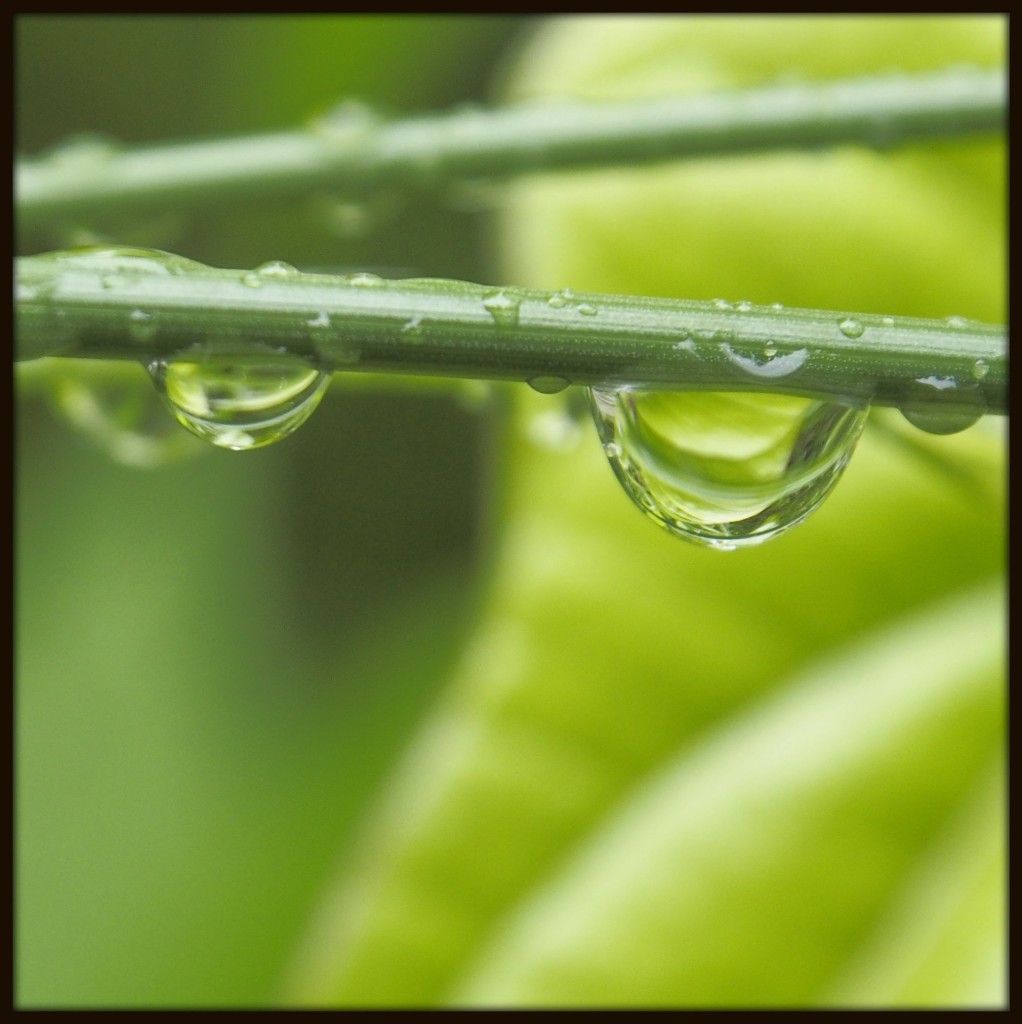
From this morning, I offer two more water droplet photographs along Piney Woods Church Road. I ought to do an exhibit on water someday….