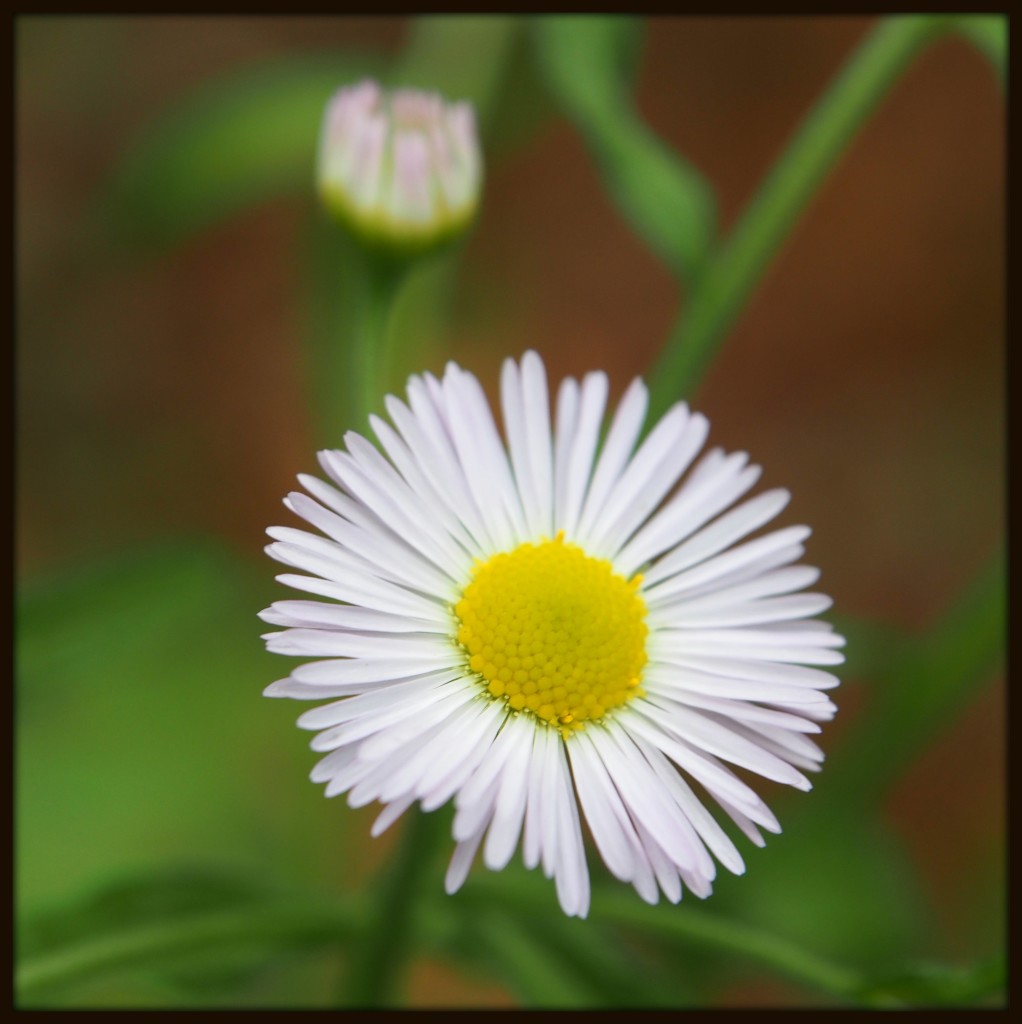
Join me on a Georgia roadside walk in mid-spring, and let us see what flowers we might gather in honor of Mother’s Day. Most wildflowers of the rural road edges do not hold up well cut and placed into a vase; they thrive better where they grow, in ditches or along embankments. For this reason, we will seek instead a photographic bouquet, which lasts far longer and (in the case of our thistle species, at least) is far less prickly. One of our first discoveries, perhaps because it is so abundant, is a plant with stalked clusters of yellow flowers, vaguely reminiscent of a brown-eyed Susan without the brown eye and with fewer petals. The basal leaves of the plant are somewhat elliptical in outline and highly serrated. The plant is Southern ragwort, also called Small’s ragwort (Senecio anonymus), a member of the Aster or Sunflower Family. Although used medicinally by Native Americans, this native plant has been found to contain toxins that can cause a number of ill effects, and should best be appreciated for its visual qualities only.
.JPG)
Rough cat’s ear; photograph by author.
Continuing down the dusty gravel road, we pass an extensive grassy area filled with flowers that look like over-sized dandelions. They rise above the ground up to two feet on their slender stalks. Their leaves are all in a rosette at the base, and look nearly identical to those of the dandelion, only a bit larger. The plant in question is the rough cat’s ear (Hypochaeris radicata), a Eurasian plant that is now widespread across the United States. Unlike the ragwort, this plant is a worthy salad additive; both the young leaves and the flower heads can be eaten raw.

Low hop clover; photograph by author.
Next we encounter a clump of low, clover-leaved plants, each having bright yellow heads that with forty minute florets each. Called low hop clover (Trifolium campestre), the plant is a Eurasian native that has become established throughout the United States. Because it is a legume (a member of the Bean or Pea Family), it helps to add nitrogen to the soil. (Nitrogen is a nutrient necessary for plant growth.) As the flower head dies, the florets all droop downward, making the head appear like dried hops. While blooming, the flowers are frequented by honeybees.

Beaked corn salad; photo by author.
Our next discovery is an inconspicuous plant with minute, five-lobed white flowers, having a most distinctive name. Called beaked corn salad (Valerianella radiata), it can be identified by its forked stem with sessile stem leaves (meaning that they are attached directly to the stem, without a petiole). Its name originates from its habit of growing wild in corn fields. The leaves make an excellent salad ingredient, with a delicious nutty flavor. The European corn salad (Valerianella locusta) is nearly identical but has pale blue flowers. A popular green, it is also called lamb’s lettuce.

Bull thistle; photograph by author.
Our Georgia roadside walk would not be complete this time of year without spotting one thistle blooming in a pasture or roadside ditch (or, as cattle farmers who consider it a noxious weed would prefer to call it, a “blooming thistle”.) Closely related to artichokes, thistles are almost entirely edible, from their roots and leaf ribs to their flower stalks and flower heads (equivalent to the artichoke heart). They are edible, that is, if one has a lot of patience, a lot of time, and a lot of thistles. For our purpose, this purple bull thistle from Eurasia (Circium vulgare) will add a splash of vibrant color to the whites and yellows of our bouquet.
For more information about Georgia’s wildflowers. this author recommends that you obtain a copy of a good wildflower guide, ideally Wildflowers of Tennessee, the Ohio Valley, and the Southern Appalachians, listed here.
This article was originally published on May 8, 2010.