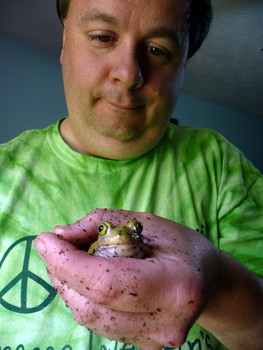
Author with Couch’s spadefoot toad
My name is Clifford Blizard, and I keep frogs. There. I’ve said it. I have terrariums set up all around my home office, full of different species of frogs. A new, large terrarium awaits setup in the living room; once it is ready to house its intended occupants, I will move it into the office as well, after rearranging several bookshelves in order to have necessary space. I used to think that my ideal office would be lined with wall-to-wall books; lately, I have decided that wall-to-wall frogs would be even better yet.
My wife and I love animals. We have many housecats and several small dogs, plus turtles, salamanders, and a bearded dragon. I enjoy all of our other-than-human companions. But I have a particular fondness for frogs. Maybe it is their confident, sometimes even smiling facial expressions, or possibly their various vibrant colors (particularly the poison dart frogs), or perhaps their placid temperaments. I enjoy the sound of frogs calling, too, though just our White’s tree frogs have has deigned to do so thus far, and only at certain stimuli – most notably, the opening theme to Doctor Who. For whatever reason or reasons, I have become quite enamored of frogs. In this article, I would like to share a bit of that passion with my readers, offering some guidance (and encouragement) to others who might consider keeping frogs in their homes.
The first thing to know about frogs is that they are highly varied in appearance, behavior, locomotion, and food and habitat needs. Some frogs are strictly aquatic, while others spend most of their lives buried underground, only emerging after a heavy rain. Some of the larger frog species are solitary and spend most of their lives motionless, waiting for hapless prey items (such as crickets or even mice) to wander by. Others are social, living in groups of half a dozen or more and ranging freely along a forest floor or clambering among the trees. For this reason, it is very important to choose a particular frog species and research its needs thoroughly before buying one or more of them for your home. In this article, I will offer a brief overview of some of the frogs that I have adopted. I am a relative beginner to frog care myself (I have had frogs in my home for less than a year), so the ones I will recommend are all “beginner” species – ones that do not pose major challenges to maintain. After the overview, I will close with recommendations on how to obtain healthy frogs for the home in an ecologically responsible way.
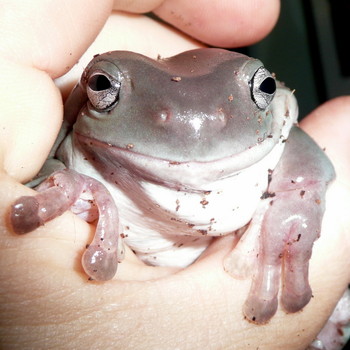
White’s tree frog (also known as Dumpy tree frog)
White’s tree frogs (Litoria caerulia, also known as “Dumpy” tree frogs) are an ideal “first frog” for the home. Native to Australia and Indonesia, these solid, placid, mild-mannered frogs average four inches in length, with females occasionally growing to five. Although they are tree frogs (as evident from the broad pads on their forefeet), they tend to be fairly inactive when not hunting. Active (well, active by White’s tree frog standards, anyway) at night, they spend their days curled up in a hollow log or perched on a tree branch. As you can see from the photograph above, they don’t seem to mind being handled, and they are fairly hardy. Adopting one is a serious commitment, though; White’s tree frogs have been known to live for up to 21 years in captivity. Because they are fairly large frogs, they need a lot of room. Two or three frogs require at least a twenty-gallon glass terrarium. The base of the enclosure should be lined with coconut coir fiber or a similar substrate, and the terrarium should include a number of plants (live or artificial) and branches or sections of bamboo for climbing and perching. A water dish several inches in diameter and a few inches deep is needed. Like most all of my frogs, the White’s tree frogs feed on live crickets.
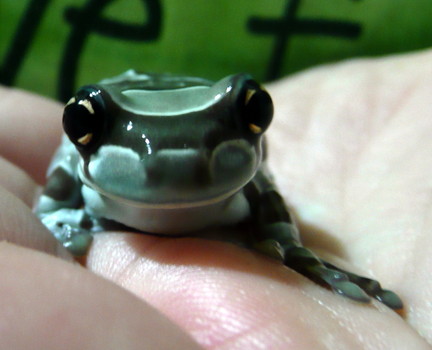
Amazon milk frog
While White’s tree frogs are fairly common in pet stores, Amazon milk frogs (Trachycephalus resinifictrix) are just now becoming popular with hobbyists. It is easy to see why. Native to the lowland tropics of South America, these highly attractive black, white, and gray frogs are charming, with facial expressions that seem almost puppy-like. Like White’s tree frogs, they grow to four inches in size; they can live in captivity for ten years or more, feeding contentedly on crickets. Their name comes from a white sticky secretion that they excrete when stressed. Based upon my experience caring for them (and holding them) without this happening, they seem to stress much less easily than I do. Milk frogs enjoy opportunities to swim, so a large water bowl should be included in their enclosures. They also appreciate highly humid environments, so misting them once or twice a day with a water bottle is also a good idea.
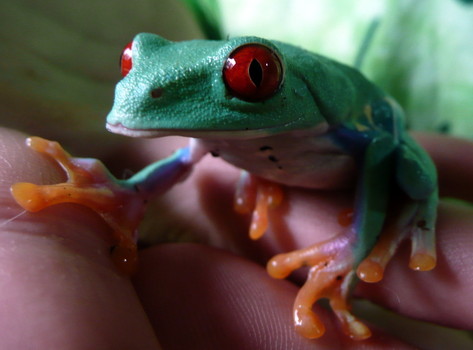
Red-eyed tree frog
One more charming tree frog that the dedicated beginner might consider is the red-eyed tree frog (Agalychnis callidryas). This arboreal frog is native to Costa Rica and is decidedly nocturnal in temperament. Red-eyes will spend their days snoozing away, curled up on a leaf or clinging to the glass of terrarium. At nightfall, they languidly open their eyes, yawn a few times, and slowly stretch out their limbs, Somehow, although they tend to move with kabuki-like slowness, they still manage to catch plenty of crickets. Red-eyed tree frogs have lanky bodies, making them a bit more fragile than the solid (flabby, even) White’s tree frogs. Like the milk frogs, they require high humidity conditions. Some care sheets discourage beginners from buying these frogs, because they tend to be more expensive than other frogs and should be handled less often because of their more delicate bodies. I have found, however, that they require no more care than the milk frogs do. To fully appreciate them, I recommend getting a red flashlight or bulb, so that you can view their nighttime antics as they roam their enclosure and hunt for prey. Because they spend so little time on the ground, red-eyes do better in an upright glass terrarium than a horizontal one. That way, they can have plenty of space for climbing on branches, lengths of bamboo, and plant leaves.
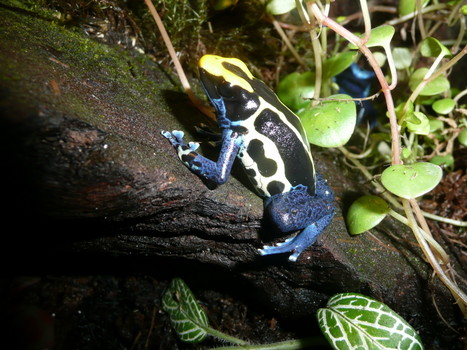
Poison dart frog (Dendrobates tincturious “Yellowback”)
Another option for the beginning frog aficionado is one of the various kinds of poison dart frogs. Unlike tree frogs, poison dart frogs are relatively poor climbers, spending much of their time on or near the ground in their native habitats of the South American tropics. They are much smaller than the previous frogs I have discussed, rarely reaching two inches in length and many topping out at an inch or even less. Most species are highly colored, such as the Dendrobates tincturious “Yellowback”. Their colors (which range from vibrant yellows and oranges to metallic shades of turquoise and blue) warn would-be predators in the wild that their skin contains a potent toxin. Indeed, several species of poison dart frogs were actually used by South American Indians as a source of poison for blow-darts for hunting (hence their collective name). Fortunately, the frogs gradually lose their toxicity in captivity; however, it is still essential to handle them as little as possible, and only while wearing latex gloves. Another challenge to raising poison dart frogs is feeding them. Because they are so small, they favor wingless fruit flies over crickets. While crickets can be ordered live online with ease, the best way to have fruit flies on hand is to buy a fruit fly culturing kit and raise your own. So those seeking to care for poison dart frogs should plan to care for their prey as well. However, the rewards of adding poison dart frogs to the home are many. These frogs are like tiny hopping jewels, with rich colors unlike practically any other animals on Earth. They are enthusiastic feeders, snatching up vast numbers of fruit flies with their tongues. They are also quite intelligent, recognizing when their caretaker is approaching to feed them, and moving quickly into position near the front of the terrarium. There are also dozens of choices on the market, with natural color morphs (varieties) of many different species currently available. Keeping poison dart frogs can be an expensive hobby, though; individual froglets range from $35 to $75 or more each. And who can stop at just one?
Assuming that this article has convinced you to consider adding one or more frogs to your home, how does one go about doing so? One thing that makes frog keeping both exciting and a bit difficult is that frogs are much less commonly kept as pets than many other “herps” (reptiles and amphibians), such as geckos and snakes. Only a few frogs can be found in most pet shops, and I have yet to encounter any of the ones I talked about in this article in a “big box” pet store. Occasionally, a frog will appear for sale on Craigslist; in my experience, buying a frog from a former keeper can be a risky proposition, though. One advantage with this approach is that the frog or frogs will often come with a prepared terrarium, making initial setup much easier and less costly. However, many frog owners do not do their homework on the needs of the particular frog that they are caring for, and the result is an animal that may already be stressed or ill by an inferior environment. Therefore, the best route by far for the beginning frog keeper is to purchase frogs (usually sold as juvenile froglets, one or two months beyond the tadpole stage) from a reputable dealer, either one at a reptile show such as Repticon, or else one available online. For about $40 in shipping, a group of froglets can be sent overnight mail and will arrive ready to occupy a new terrarium and start feeding right away.
One very important consideration when purchasing frogs is to determine whether the animals for sale are wild-caught or captive-bred. I strongly urge you to avoid wild-caught frogs. These frogs were taken out of their native environment, which (given all the other pressures frogs face, from habitat loss to global warming) could threaten popular species with extinction. Wild-caught frogs often have parasites that those born and raised in captivity do not. One superb source of 100% captive-bred frogs is Josh’s Frogs. I have ordered three times from this company, and cannot recommend them enough. Josh’s Frogs is dedicated to protecting wild frogs by supplying buyers with healthy captive-bred ones instead.
If you are interested in adding frogs to your home, I encourage you to start with reading about possible frog species of interest, and what care they require. Josh’s Frogs has an extensive collection of “how to” guides, available here. An excellent introduction to keeping frogs and toads is provided by Frogs and Toads (Complete Herp Care), available at Amazon and other online booksellers and neighborhood bookstores.
This article was originally published on July 8, 2013. Photographs copyright Valerie Hayes.