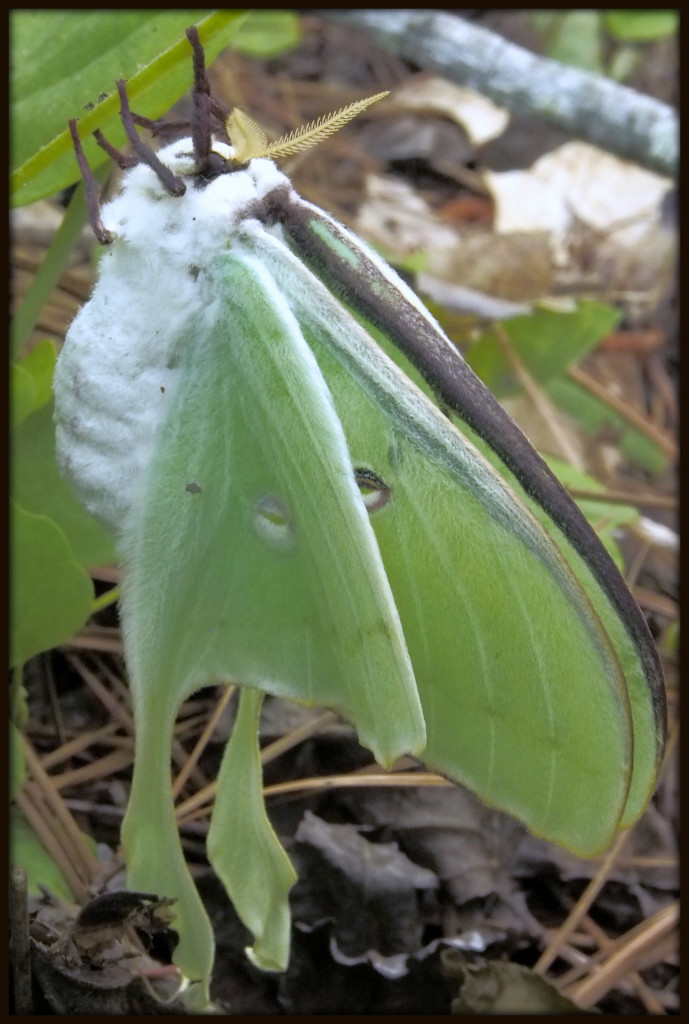
“Caterpillar sheds his skin, to find a butterfly within,” Donavan sang in his 1967 Billboard #11 hit song, “There is a Mountain.” The tune, with its simple Buddhist-inspired lyrics and a lovely, catchy flute melody, was recently revived in a recording by Kenny Loggins. In the 2009 Disney music video, Loggins is encircled by joyful young children clapping and shaking tambourines. But metamorphism in insects is far from child’s play. In fact, Donavan’s picture is highly inaccurate. A caterpillar des not molt to reveal a butterfly inside. Instead, it forms a chrysalis, inside which the caterpillar’s body completely dissolves, reconstituting itself as an entirely new organism, a butterfly. Metamorphism in butterflies is much closer to the mythical phoenix rising from the ashes than an actor stepping out of one costume to reveal another one. It is as if two different actors are involved: one to play the role of the caterpillar, the other the butterfly. According to Darwin’s theory of evolution, this odd process developed gradually, in stages, over a vast amount of time. But have you ever stopped to wonder how that could have happened?
Frank Ryan’s 2011 publication, “The Mystery of Metamorphosis: A Scientific Detective Story” explores the question of how metamorphosis may have come about. Strangely enough, metamorphism in animals has not been studied as much as one might imagine. In fact, the currently dominant theory of gradual evolution does not work very well, particularly in cases of metamorphism that occur among invertebrates living in the ocean. And that is where the research of Donald Williamson comes in, and where “The Mystery of Metamorphosis” opens.
Donald Williamson has been studying for decades the larval forms of various sea creatures, including sea stars, brittle stars, sea urchins, and sea squirts. These organisms are classified by their adult forms, because often their larval forms are nothing like the adults. What is even more odd is that not all of the species of these organisms actually undergo metamorphosis at all. A few do not. Others go through very strange metamorphoses indeed. One sea star, Luidia sarsi, has a bilaterally symmetrical, free-swimming larva. Inside the gut of this larva, a tiny adult sea star develops. The larva does not change into the adult. Instead, the larva eventually “births” the adult form, and then continues living for a time on its own, without reproducing. Eventually, the radially symmetrical adult sea stars will reach sexual maturity, broadcast egg and sperm into the water, and the result will be a new generation of larvae.
Then there are the sea squirts. As adults, they look like strange glass tubes attached to the sea floor or perhaps a boat bottom, where they spend their days pumping water into their bodies through one opening and releasing it through another. With the exception of a few diehard couch potatoes, there is no human equivalent to this sessile, brainless organism. As larvae, however, sea squirts resemble miniature tadpoles, with primitive brains and spinal cords. Inside the larval tissues, the adult form begins to develop, almost like a parasite – as if there were two different organisms involved rather than just one. When they are ready to become adults, sea squirts sense the presence of a suitable substrate to attach to, point their bodies head-downward, and begin to lose all of their larval properties. Their tail dissolves, and so do their brains – all to be reconstituted in the adult form.
Studying these odd forms, Williamson proposed a daring evolutionary explanation. What if, early in the history of life, species boundaries weren’t as tightly defined as now? What if organisms were able to hybridize with other organisms of different species, different classes, perhaps even different phyla altogether? Since reproduction took the form of broadcast spawning, it would have been possible – quite likely, in fact – that there were many pairings of egg and sperm from entirely different organisms. If some of these pairings were successful, the result could have been a new organism, maintaining characteristics of both of its forbearers. In such a way, organisms might have developed larval forms that they did not have previously. Imagine the creative potential of a world where cross-hybridization took place! As Ryan relates toward the end of his book, we might not need to imagine that condition at all. Instead, we can look to the fossil record for evidence of just such a possible past, toward the dawn of multicellular life, over 500 million years ago.
Ryan’s book is captivating, even a bit jarring, with its proposal that there may be much more to evolution than the gradualist model proposed by Darwin. “The Mystery of Metamorphosis” is an excellent reminder that there is much that is still unknown, that the development of life on Earth still holds many wonders to explore. It is not easy going, particularly for the reader not schooled in biology in general and the nature of insect homones in particular. But it is worth the journey to explore such wild ideas as these, ideas that conventional Darwin’s Theory of Evolution by Natural Selection might declare impossible. But as Shakespeare observed in “Hamlet”, “There are more things in heaven and earth, Horatio, than are dreamt of in your philosophy.”
This article was originally published on August 19, 2011.