Apr 282014
 

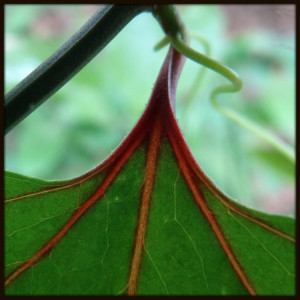
I set out down Piney Woods Church late this afternoon with lifted spirits, following an encouraging note from a friend, reminding me that all the changes I saw yesterday will soon be undone by nature, in the form of rain, wind, and new growth.  Meanwhile, I discovered all sorts of possibilities for photographs today.  The image I selected is a close-up of the point where the leaf of a vine connected to the main stem.  It marks a confluence, where all of the veins in the leaf come together.  Also at the join, two long trendrils emerge from the plant, helping it to climb over any obstacles and cling to anything in its path.  Most likely, the plant is one of two possible species (both invasive) in the genus Discorea:  either the air-potato (Discorea bulbifera) from Africa, or the Chinese yam (Discorea oppositifolia) from Asia.  The two are difficult to distinguish (my bets are on the Chinese yam), but both plants are considered highly invasive.

One thing I have noticed from all my explorations of roadside plants is that most of them are non-native, and they harken from a variety of homelands.  Many are from Europe, but others are from parts of Asia or even Africa.  I am coming to realize that a rural Georgia back road can be a much more cosmopolitan place than I had previously imagined.

Confluence

Apr 272014
 

A poison ivy vine blooms in the May Day sunshine in Chattahoochee Hills, Georgia.As spring advances, the observant naturalist notices an array of flowers coming into bloom along roadsides and forest paths.  One flower blooming now that is easily missed belongs to a leafy vine that should not be overlooked:  poison ivy (Toxicodendron radicans).  Few of our native plants have as black a reputation as this member of the cashew family, frequently encountered along forest edges, roadsides, and in other disturbed areas.  After all, how many other native plants are the subject of rhymes about their dangers?  “Leaflets three / let them be.”

Certainly poison ivy’s reputation is, to some extent, richly deserved.  Unless you happen to belong to the twenty percent or so of the population that can handle poison ivy plants with impunity, contact with them can have memorable but unpleasant consequences.  Poison ivy’s shiny leaves and hairy vines both contain an oily sap, urushiol, which can penetrate the skin and provoke an allergic reaction that produces a rash, blisters, intense itchiness, and general misery.  Some people are so sensitive to this allergen that merely coming into close proximity with poison ivy may be enough to have an effect.

But with respect for those so severely afflicted, poison ivy is actually a highly beneficial plant for our native wildlife.  Strangely enough, humans appear to be almost its only animal victims.  White-tailed deer actually forage preferentially on poison ivy leaves.  But birds are the main beneficiaries.  Woodpeckers, flickers, grouse, pheasants, bobwhites, and warblers are all drawn to poison ivy’s small, spherical, tan fruits in the fall and winter.  The seeds pass through these birds’ digestive tracts, helping to spread poison ivy far and wide.  To aid in its own dispersal, poison ivy practices foliar fruit flagging, a technique also used by flowering dogwood.  In the autumn, poison ivy leaves turn to blazing shades of red and gold.  This bright coloration signals to the birds that food is available.

This early in the year, though, poison ivy sports bright-green, shiny leaves.  Beneath the leaves hang panicles (dense, branching clusters) of minute, greenish-white flowers.  In close-up photographs (such as the one available about halfway down on the left on this page), the minute flowers with their five petals forming a star and their white and yellow pistils and stamens look almost elegant.  But to appreciate them under a hand lens requires putting the hands, arms, and face at too great a risk to be worthwhile, in this writer’s opinion.

A hardy survivor, poison ivy spreads not only by seeds, but vegetatively as well.  The vines that appear to be hairy are, in fact, covered with rootlets, ready to take hold of a tree trunk or burrow into the soil.  Considering its predilection for covering extensive ground, this writer confesses to eying the plant with suspicion when encountering it in the yard, despite its benefits to deer and songbirds.  But inevitably, it is easiest to let a few vines be, provided they not overstep their bounds.  After all, poison ivy is here to stay.

In fact, recent studies of forest plant response to increasing atmospheric carbon dioxide levels indicate that it leads to a significant increase in poison ivy growth — on the order of 150 percent.  This result is known as the “carbon dioxide fertilization effect.”  Accompanying that surge, it appears that the increased carbon dioxide also enables the poison ivy to produce a more virulent strain of urushiol, leading to worse allergic reactions than are presently experienced.  At least we can look forward to the day when the poison ivy begins to choke out our invasive plant species — kudzu, privet, honeysuckle, wisteria, and others.  That is some small consolation, perhaps, at least for the die-hard naturalists out there.

This article was originally published on May 2, 2010.
Apr 272014
 

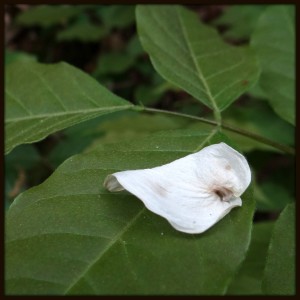
My afternoon walk down Piney Woods Church Road was an experience in letting go.  The road has been regraded — it is wider than ever before, and all the potholes and ruts are, for now, absent.  Along the roadside, it seemed as if everyone with a mower was out in force this weekend.  What was yesterday morning a sea of self-heal weeds along the road was, today, just a band of short grass with a couple of self-heal remaining that somehow escaped the blade.  The air was close and the sky gray, but not a gray that betokened the arrival of dramatic weather yet (on Tuesday, though, quite possibly).  I was in the grips of a head cold, my first illness since ten days in a hospital with pneumonia last September.  And there was practically nothing to photograph.

I settled, at last, for this image, conveying well the transience of all things.  A fallen petal of flowering dogwood rests on a Chinese wisteria leaf.  The dogwood and wisteria are both past blooming now.

Fallen Petal

Apr 262014
 

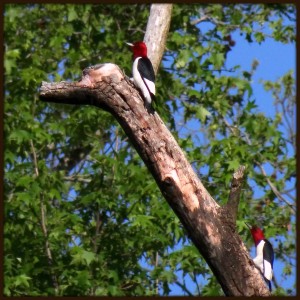
Using the digital zoom on my Sony Cyber-shot camera (a sort of devil’s bargain, enabling me to get much closer to distant objects than otherwise, at the cost of dramatic decrease in image quality), I was able to snap a couple quick photographs of a red-headed woodpecker perched high in the branches of an ancient, half-dead pecan tree.  Only later, reviewing my photos from the day, did I see the second bird, glancing up at the first one.

Two Woodpeckers

Apr 262014
 

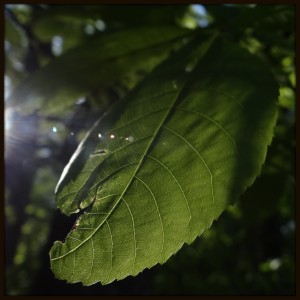
Without intention to do so, I found myself yet again this morning photographing the play of morning sunlight and green leaves.  There is so much possibility here, in the ways the early morning and late-day sun illuminate, for a brief moment, a particular leaf or plant.  The light calls to me — there is so much to wonder at that I had never noticed before.  In this particular moment captured in this image, a misshapen hickory (mockernut?) leaf catches the sunlight and becomes a form of beauty and delight.

Moment

Apr 252014
 

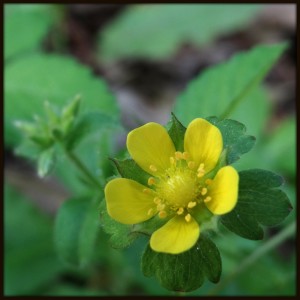
Once I identified this roadside plant as Indian strawberry (Duchesnea indica), I naturally assumed it to be a native one, somehow associated with American Indians.  Instead, this creeping plant with three serrated leaflets and prominent, five-petaled yellow flowers has become naturalized from India.  As the National Audubon Society’s Guide to Eastern Wildflowers notes, the plant is decidedly “strawberry-like”.  Its fruit’s taste is, to quote Wildflowers of Tennessee, the Ohio Valley, and the Southern Appalachians, “dry and not pleasing.”  Indian strawberry is common to waste places and lawns throughout the eastern half of the United States.

Indian Strawberry

Apr 252014
 

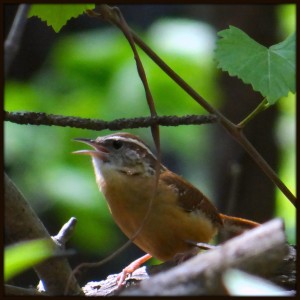
Patience rewarded me at last.  After hearing a bird making the same insistent brief call from the foliage, I spent several minutes trying to locate the source.  At last, I found a small, rather elusive brown bird, skipping from spot to spot among the branches of vines and trees.  I was able to snap a couple of quick photographs before the bird disappeared from sight.  My wife informed me that it was almost certainly a wren, and my Birds of Georgia field guide photograph of a Carolina Wren (Thryothorus ludovicianus) is nearly an exact match.  The Carolina Wren is a cavity-nesting bird that resides year-round in Georgia.

Carolina Wren

Apr 232014
 

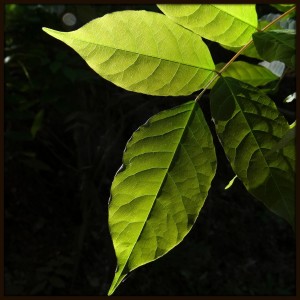
The wisteria blooms are all spent now, save for a few shriveled flower petals that haven’t yet fallen onto the roadway.  Yet, for all its aggressiveness, Chinese wisteria also offers moments of dazzling beauty.  Even after the flowers are gone, the leaves still captivate me, illuminated by late afternoon light.  They glow like the finest stained glass, turning a rural lane into a chapel for contemplating the cosmos.

Illuminated

Apr 212014
 

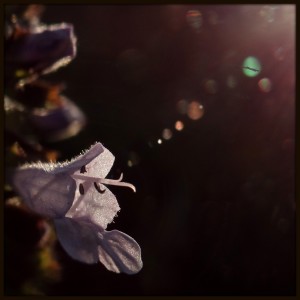
I was feeling bereft today, walking down Piney Woods Church Road, still digesting the sad and unexpected news that my favorite local hangout, a charming old-time general store, will be closing next month.  For most of my walk, wherever I glanced, the magic seemed drained from the landscape.  The wisteria blooms had withered, and all the giant red thistles, just beginning to blossom, had been uprooted by a landowner (understandably — it is a pernicious weed) along the roadside.  Some of my favorite haunts to look for wildflowers had been mowed in the last day or two.  I wondered if I would find anything inviting.  That is when I saw the blooming heal-all (Prunella vulgaris), a common introduced lawn weed throughout North America.  The late-day sun, low on the horizon, offered intriguing photographic possibilities.  The result, after a few minutes of exploration, is this sunlight striking a heal-all flower.  There is a radiance in this image that gives me cause for hope, at such a dark time.  There is solace to be found in nature, if we pause long enough to let it find us.

Healing Light

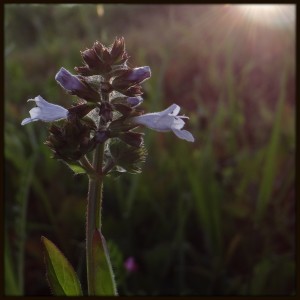
Addendum, May 22, 2014:  Here is another photograph of the self-heal from the same day’s images. I like it so much that I recently had it printed and mounted on bamboo by Plywerk, Inc. of Portland, Oregon.

Self-Heal

Apr 202014
 

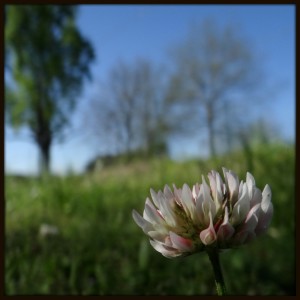
For several days, I have been trying, without success, to capture an interesting image of the white clover (Trifolium repens) now blooming along the edge of a field along Piney Woods Church Road.  Introduced from Europe, this member of the pea family is now common across North America.  So easily overlooked, in this photo white clover shines as the star of the rural landscape.

Field Clover