The tumultuous thunderstorm of early morning had passed, and the fog was lifting. I arrived at Piney Woods Church Road to discover, quite literally, a river running through it — flowing down the roadway and into the very same ruts that had been covered in ice just a few days before (see Day Seven). Now, the rut held a lovely pattern of ripple marks, sedimentary structures formed by the action of water flowing across the silt of the roadbed. I tried to take a photo of the ripple marks without any reflections present, mostly for my own appreciation as a geologist. But each time I attempted to do so, I ended up in the photograph, regardless of which side of the rut I stood, or how wet my feet became in the process. Ironically, the result was this delightful self-portrait.
As my project duration moves into the double digits (365 definitely feels like a long way off!), clouds have returned to the Georgia Piedmont. On a highly humid day (near one hundred percent), I ventured to Piney Woods Church Road in the early afternoon, in search of fog. There were light patches that helped soften the background landscape a bit, but nothing particularly enticing to photograph. Instead, though, I quickly discovered the potential of photographing water droplets suspended from the tips of leaves and branches. Using my plus four macro lens, I took dozens of droplet photos as I walked toward Hutcheson Ferry Road and back. My first — and last — photographs were taken of droplets on the leaves of cedar trees growing along the edge of a property bordering the road at its intersection with Rico Road. Facing the intersection, I framed my photos to include the brilliant red of the stop sign, out of focus in the background. Returning along Piney Woods Church Road, I wondered if it might be possible to take the same photograph, but include a vehicle driving by. The result (on the second attempt) was the image below. I have titled it “Stop Action” to reflect the juxtaposition of the car racing by with the “frozen in time” feeling created by the water droplet, with the stop sign adds further to this visual contradiction. I am tempted to add that this is probably one of my most didactic photos I have taken lately, recommending that we “stop action” from time to time in order to notice the ephemeral and the beautiful all around us. How often have we allowed ourselves the time after a light rainfall to wander the land, admiring the lingering water droplets that cover pine needles and honeysuckle vine tendrils like tiny jewels?
By the time I set out on a late afternoon saunter to Piney Woods Church Road, the leaden skies had given way to a fine mist — not quite fog, and not quite a drizzle, but approaching what Thoreau called a “mizzling” rain. It was certainly not a day for sunset opportunities. Indeed, it was one of those days that I knew, sooner or later, would happen. Throughout most of the walk, I was accompanied by a small voice in my head, telling me that I was running out of photograph opportunities, and how silly I must be for thinking that this short gravel road outside Atlanta would somehow yield a trove of images and experiences. I persevered nonetheless, dutifully photographing a rock with lichens and mosses (not in sharp focus) and a single red greenbriar leaf against a background of tan-brown fallen leaves from last autumn. I photograph both of these every day now; be watching for when they appear in this blog. I was tempted to turn back early, satisfied with either the rock or the leaf, but I continued to where Piney Woods Church Road meets Hutcheson Ferry Road. Standing in a ditch beside the intersection, I took this photograph of moss with clinging water droplets, using my +4 macro lens. I am reminded, for some reason, of a rolling Irish landscape. Perhaps because it seems always to be raining in Ireland…..
Only a couple of days ago, I recall setting off down Piney Woods Church Road, from its intersection with Rico Road, and finding deep muddy ruts along the road edge. I remember being upset by this disfigurement of my daily journey. Yet, passing by that same spot today, I discovered the beautiful, intriguing patterns of ice bubbles frozen into those very ruts. What before was unsightly has now been rendered attractive and photo-worthy. The result is this “ice mural”, an image which I can imagine painted into the side of a building in some city somewhere. The abstractions suggest a landscape with figures — but I will leave interpretations to readers. What do you see in this image?
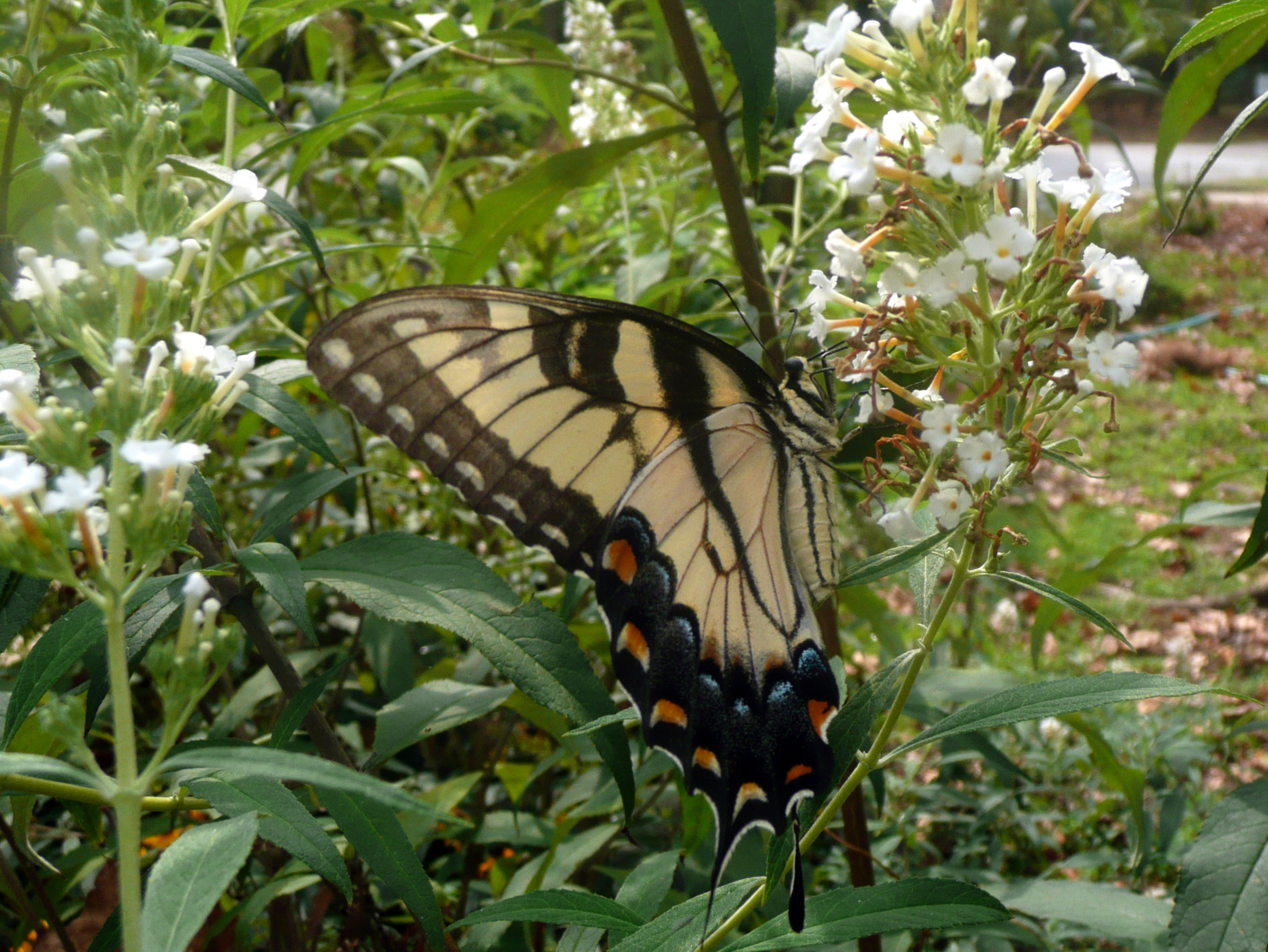
According to the book of Genesis in the Holy Bible, one of Adam’s first actions after being created was to gather together all living things and give them names. Clearly, the human predilection for classifying and naming plants and animals goes back thousands of years. It is most evident today in birders’ life lists: collections of scientific names of all the different birds one has seen over a lifetime. My own bookshelves overflow with field guides, nearly a hundred in all, covering birds, trees, salamanders, moths, mushrooms, and many other kinds of living things. In medieval alchemy, names had power to them, as shown by the fact that to spell refers both to stating the letters in a word and exerting magical influence in the world. Nowadays, to know the name (common or scientific) of a plant or animal is enough for a naturalist to find dozens of images and species accounts scattered across the Web. It is possible to take a digital photograph of a butterfly in the morning and spend the rest of the day indoors and online, reading about the butterfly, its life cycle, host plants, behaviors, etc.
But naming is only one access point into learning about the natural world. And particularly for children, perhaps names are not the best place to start after all. The naturalist Barry Lopez warns, in his book of essays, Crossing Open Ground (pp. 150-151), “The quickest door to open in the woods for a child is the one that leads to the smallest room, by knowing the name each thing is called. The door that leads to a cathedral is marked by a hesitancy to speak at all, rather to encourage by example a sharpness of the senses.” Once we learn a name for something, there is a sense of completion, a suggestion that it is all that is necessary. Yet there is so much more out there to discover. When we take the time to study the more-than-human world closely, we begin to notice how trees and insects have individuality and personality of their own. A label just captures a static form, while living things are always changing. Caterpillars become butterflies, and a holly bush outside my window comes into bloom and suddenly swarms with bees and other flying insects craving nectar.
Thinking back to my own childhood (with many hours spent running barefoot across neighbors fields or tromping through a woodlot behind my house), I recall how few plants and animals I could identify. I knew what poison ivy looked like, and my brother taught me about jewelweed because it could be used to treat poison ivy. There was a shrub that grew in several places in the yard that I was confident was witch hazel; a few years ago, I learned that it was actually spicebush. There were dandelions, bane of my father, resident Lawnkeeper. And then there was Queen Anne’s lace, or wild carrot. My brother taught me that one, too. It’s roots tasted quite similar to carrot, but their texture was much closer to that of many strands of dental floss twisted together. In the front yard, there were black walnut trees that periodically covered the lawn with large green nuts, and in the far front, by the road, a stately sycamore that I learned in school was one of the oldest deciduous trees in the evolution of life on Earth. Animals I knew only by categories: ants, spiders, squirrels. My knowledge of classification was ad hoc and full of holes, having as much to do with uses plants could be put to as anything else.
I am in good company. Even the famous biologist E.O. Wilson recognized that this kind of nature experience may be more important in fostering a love of nature and sense of wonder about the environment around us. In his autobiography, Naturalist, he wrote (pp. 12-13) that “Hands-on experience at the critical time, not systematic knowledge, is what counts in the making of a naturalist. Better to be an untutored savage for a while, not to know the names or anatomical detail. Better to spend long stretches of time just searching and dreaming.” Wilson went on to quote Rachel Carson’s essay, The Sense of Wonder, in which she commented that “If facts are the seeds that later produce knowledge and wisdom, then the emotions and the impressions of the senses are the fertile soil in which the seeds must grow. The years of childhood are the time to prepare the soil.”
How, then, to encourage children to connect with nature, if not by way of field guides? One approach would be simply to encourage children to go on backyard safaris, to see what they can discover and study it closely. All that is needed are long pants and repellant against ticks and chiggers, knowledge of how to avoid fire ants, poison ivy, and other hazards of going adventuring, a magnifying lens, perhaps a jar with holes in the lid, maybe even a digital camera, and plenty of time. I suspect the child will return with tales of sights and wonders you had not imagined before.
Another activity is to choose a few trees and shrubs, observe them closely with a child, and encourage him or her to give them names. Periodically over the seasons, the child can be encouraged to revisit Bendy Tree and Prickly Shrub. How are they changing day to day, and season to season? Are there new visitors to the tree that weren’t there before? Are the leaves just unfurling, or are they perhaps riddled with holes from someone’s latest meal? Eventually, as the child gets to know the plants better, and is on familiar terms with them, he or she may inquire after their scientific names (or at least their common ones). Then it will be time to break out a field guide. The name will add one more layer of knowledge to what is already there, rather than being sufficient by itself. There is so much about nature hidden beneath the names, like salamanders beneath cobbles in a stream, just waiting to be explored.
This article was originally published on April 30, 2012.
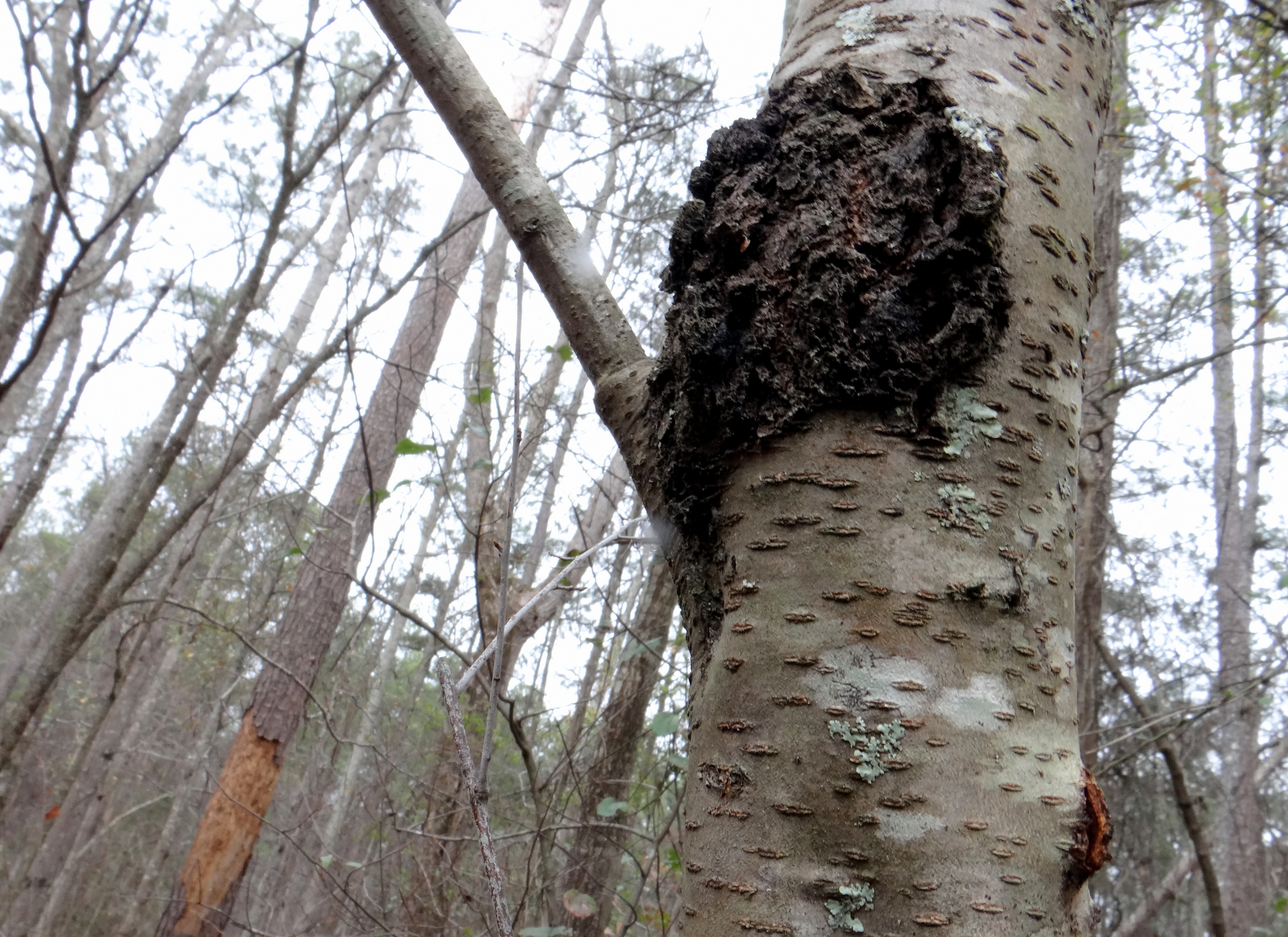
A grim, overcast day greeted me for the start of a new year and my new project documenting the Piney Woods Church Road landscape. So much for plans to begin with a sunrise. Instead, I leisurely made my way to the road late in the afternoon, an hour or so of what passed for sundown. Glancing into a grove of trees between Piney Woods Church Road and Rico Road, my eye was caught by a loblolly pine (Pinus taeda) that has most likely been killed by the southern pine beetle (Dendroctonus frontalis), an insect measuring only 2 to 4 millimeters as an adult. Closer at hand, a young pin cherry (Prunus pennsylvanica) growing beside the road has been disfigured by crown gall, a woody tumor caused by the bacterium, Agrobacterium tumefaciens. All around me, tiny organisms were slowly devouring the forest.
I would like to announce a new weekly blog feature: posts from my years writing for The Examiner, in my role as the Atlanta Nature Examiner. Now that The Examiner has made viewing its posts a bit like walking through a minefield (with not only pop-ups, but pop-unders, pop-overs, and blaring videos that begin unexpectedly), I am transferring my writings here, one at a time, every Sunday during 2014 (and perhaps beyond). I hope that you enjoy them. For those that are courageous enough to try to view them in their original location (along with all the others not yet transferred), they can be found here.
This article was originally published on April 20, 2010.
Once upon a time, the Piedmont of Georgia was blanketed in a rich, black topsoil, covering the rolling landscape to a depth of between four inches and a foot, and in places, even more. Rich in organic matter, this “A horizon” (as the upper layer of a soil profile is called) nourished a forest of predominantly oak, hickory, and pine.
Beneath the topsoil was a nearly infertile “B Horizon” of what is now called Georgia red clay. Leached of nutrients including calcium, magnesium, and potassium, the layer was stained red from iron oxide (rust). Because of this leached, clay-rich layer, the soil would have been classified as an ultisol, a soil type common in long-stable, humid temperate forests. The result of thousands of years of intense weathering, ultisols can be found throughout the Southeast.
But then the settlers came and cleared the land. Plantation owners and sharecroppers planted row crops, especially cotton. The result was dramatic soil erosion. Enormous gullies formed in abandoned fields, carrying the topsoil away into rivers like the Chattahoochee and the Oconee, and eventually into the Atlantic Ocean and Gulf of Mexico. The A horizon was lost across nearly every acre of the Georgia Piedmont.
Now all that remains is the Georgia red clay. Referred to as a “cultural icon” by a failed General Assembly bill in 2006 that would have designated it as the official soil of Georgia, it is a soil without a top layer, stripped of most of its nutrients. Nowadays, farmers apply hefty amendments of fertilizer before the soil will yield much. A local organic farm here in Chattahoochee Hills, where this author resides, trucked in large piles of compost in order to make the soil fertile enough to plant. Left alone, somehow the red clay is sufficient to grow a forest composed principally of sweet gum and loblolly pine.
The topsoil, meanwhile, has been lost, perhaps forever. Maybe, given a couple thousand years of careful stewardship of the land, it can be restored to the parts of the Piedmont not covered over with asphalt or buildings. Meanwhile, it seems fitting to offer at least a few humble words in its memory.
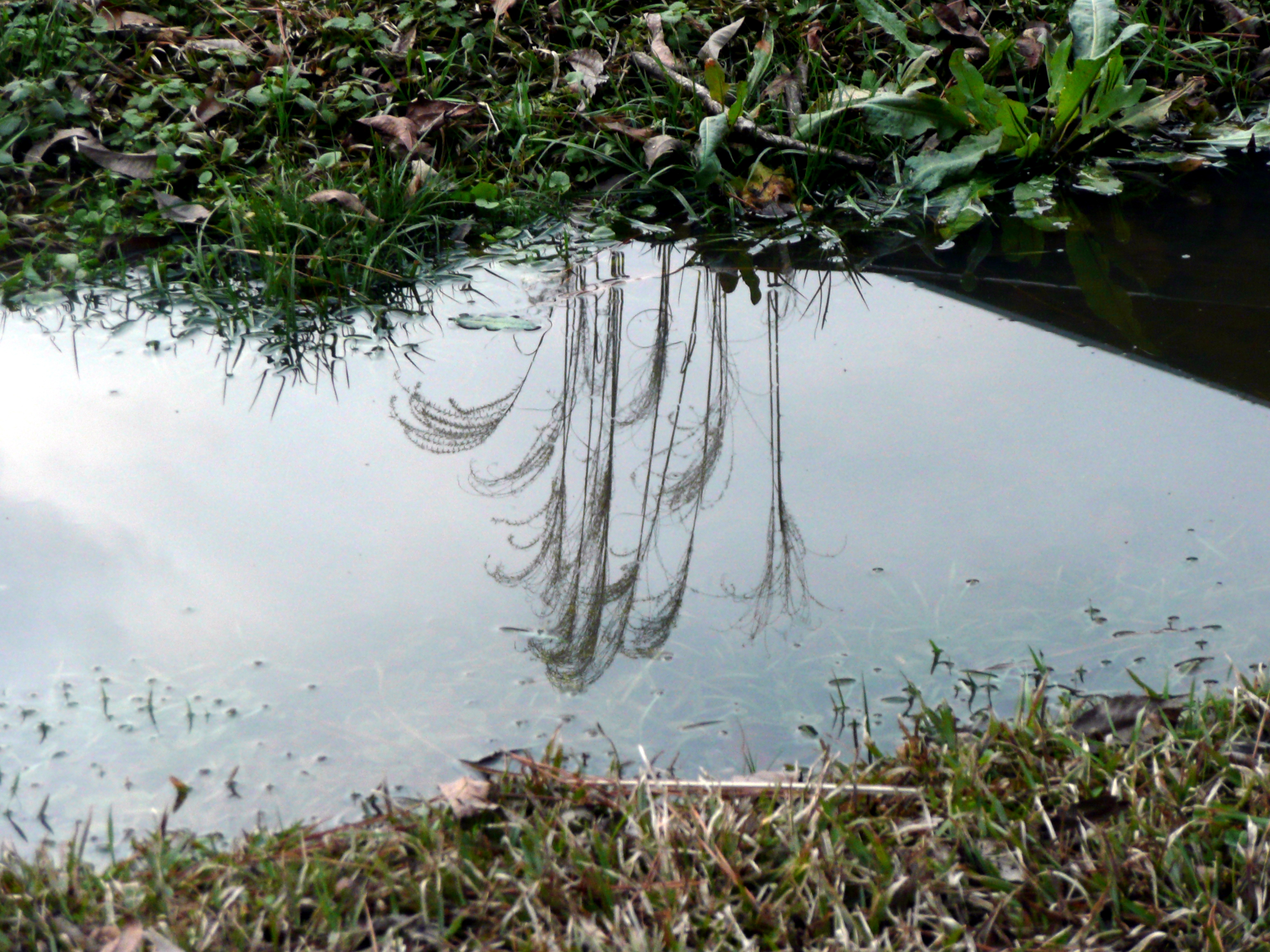
On my measuring walk the other day, I stopped midway to take this photograph of ornamental grasses reflected in a drainage ditch along the roadside. The pattern of stripes, along with the image of the reflected grasses in the middle, reminded me of a tri-color flag with emblem (such as a coat of arms) in the center. So I shall declare it, for now, the official flag of Piney Woods Church Road.
“The journey of a thousand miles begins beneath one’s feet.” — Lao Tzu
Where does the journey of 0.44195 miles begin? Answer: At Rico Road, or at Hutcheson Ferry Road, depending which way one is headed — southwest or northeast.
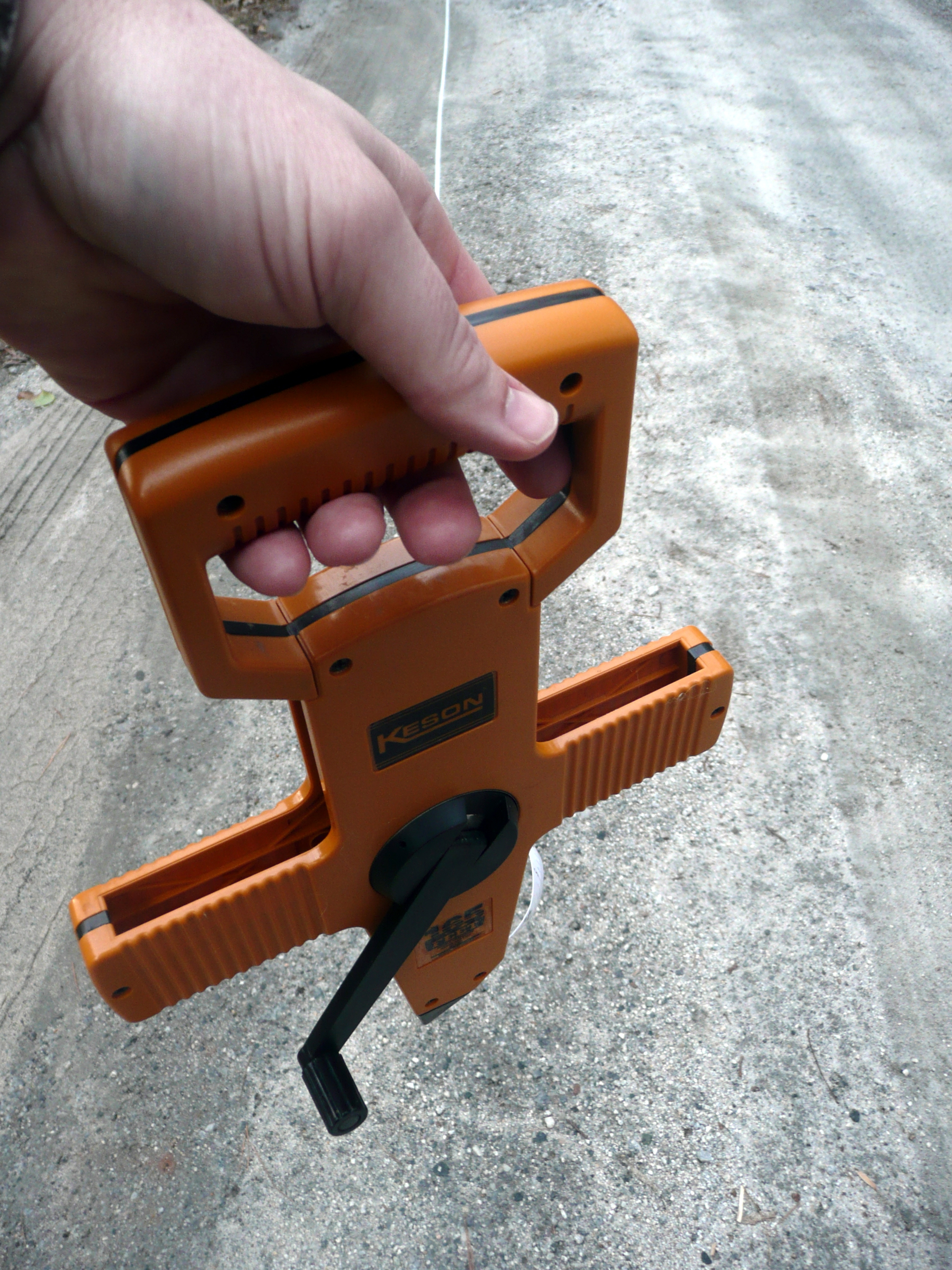
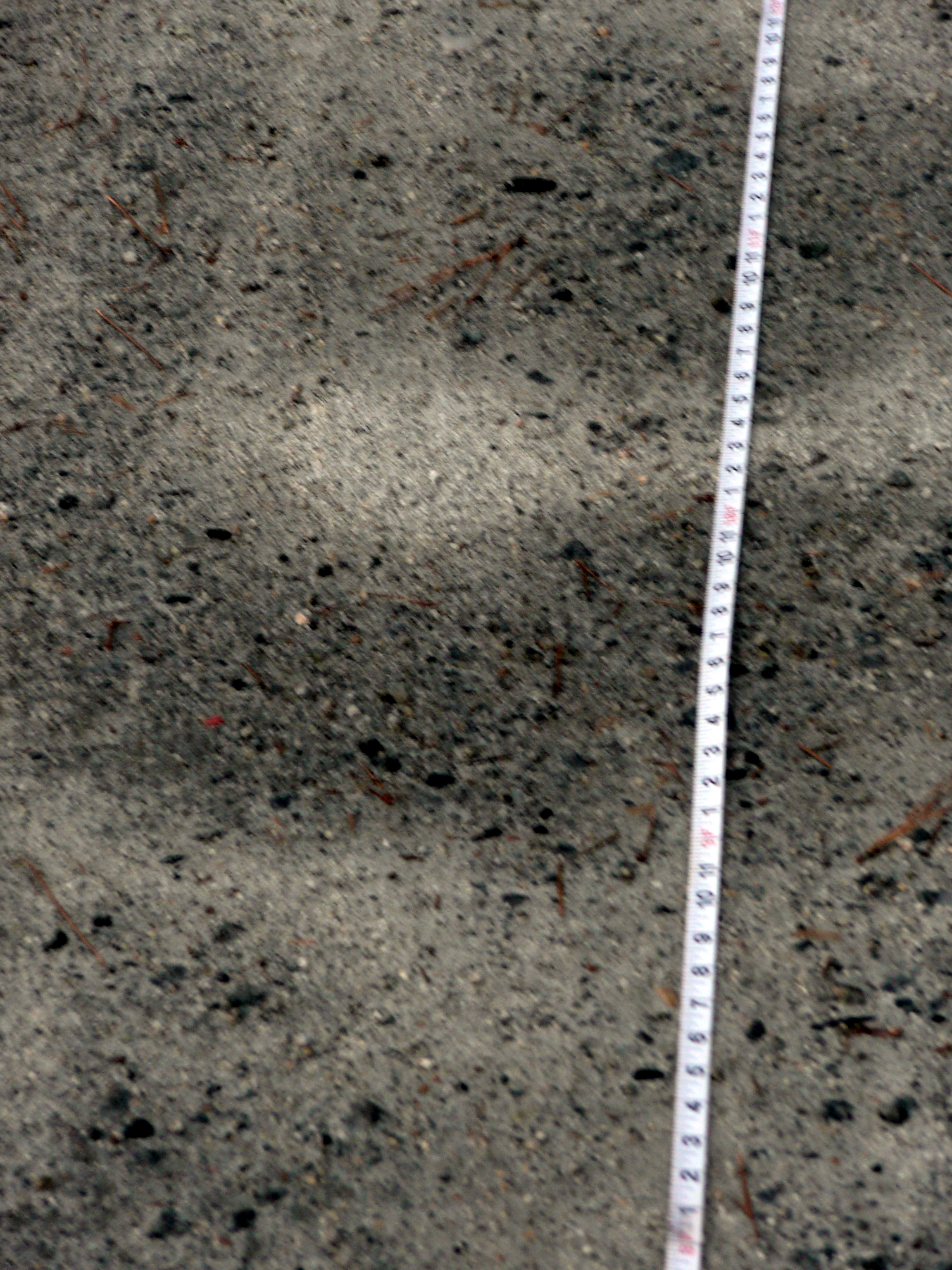
Yesterday, armed with a 165-foot measuring tape and aided by my wife as trusty field assistant. I ventured out to Piney Woods Church Road, to measure the extent of my daily journey in the year ahead. I am not quite sure why I decided to measure the road’s distance. It’s length has long been an object of mild curiosity to me, given that I have walked it with my wife and our various dogs over a thousand times in the past seven years. But, as my GIS-trained wife wisely noted, I could obtain a fairly accurate measurement without leaving the computer, thanks to Google Earth.
Part of my inspiration came, as it so often does, from Henry David Thoreau. In Walden, Thoreau explained his decision to sound the depths of Walden Pond. “There have been many stories about the bottom, or rather no bottom, of this pond, which certainly had no foundation for themselves,” Thoreau observed. “It is remarkable how long men will believe in the bottomlessness of a pond without taking the trouble to sound it.”‘ And in a similar way, I have journeyed Piney Woods Church Road so many times, and never set out to find out its actual distance.
There is also a term in the remote sensing field, “ground truthing,” which refers to double-checking measurements and observations made from satellite images or aerial photographs by going into the field. I am intrigued by the phrase, because it acknowledges (in this age of technological wonders) the benefit of walking the ground and measuring the road itself.
After the first couple of 165-foot increments (measured very slowly, unwinding the tape its full length, then winding it up again and moving on), we fell into a rhythm. I held one end of the tape, my wife the other. In turns, we would walk the full distance, pulling the unrolled tape behind us. When it was my turn to stand and hold the tape still, I would listen to the shrill whistle of the fiberglass tape sliding along the gravel, breaking the stillness of the late afternoon air.
Our last measurement was only a partial one. After traveling fourteen times the length of tape from where we began along Rico Road, the last tape length was only 23 1/2 feet, to the edge of Hutcheson Ferry Road, where the stop sign reminded us to go no further. The total distance, in feet, was 2333 1/2. Taken twice (out to Hutcheson Ferry Road and back to Rico again), my daily journey in 2014 will be 4667 feet, or 0.8839 miles. There is an additional distance, of course, from my back door to where the road begins. Perhaps I will measure that, too. Someday….
This post marks the beginning of a blog that I intend will span at least a year, time spent investigating the wonders of the everyday, developing a more nuanced appreciation of my home territory in Chattahoochee Hills, Georgia. The intended centerpiece of this site will be a daily series of visits to a nearby gravel byway, Piney Woods Church Road, to take daily photographs over the course of the year 2014. Additional posts will explore natural history in and around the Georgia Piedmont, along with musings about prehistory, landscape, and the meaning of place.
Having lived over seven years now on the same parcel of land in Georgia (longer than I have lived anywhere, apart from my formative years in Pennsylvania), I have been seized with wanderlust and thoughts of hitting the road in search of another place — Utah, Florida, elsewhere. In this blog, I will indeed spend a year “on the road” — on the same road, the one that runs parallel to and a few hundred feet beyond the wooded back edge of my property, linking Rico Road (where I live) to Hutcheson Ferry Road. It has become as commonplace as imaginable — the site of innumerable dog walks over our years living here. I have walked it often enough that I have probably taken the equivalent of several hundred miles of footsteps along it. Yet all my journeys, so far, have been about exercising the dogs, about performing a necessary act. This year, I will indulge myself in the luxury of exploring the road for the sake of the adventures I might find, the wonders I might uncover. It is a journey inspired in large part by Mark Hirsch, who spent over a year chronicling the life of a burr oak in southwestern Wisconsin in That Tree (a book, Facebook page, and calendar now). He found that the experience transformed his life. Is it too much to consider the possibilities of how such an exploration as this might touch my own? Ultimately, the experiment (currently called the Piney Woods Church Road Project) is as much personal as scientific. What does it mean to devote a year to visiting the same place, a year dedicated to seeing it anew every time?