Apr 232014
 

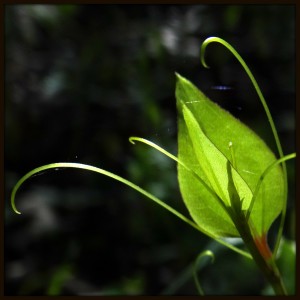
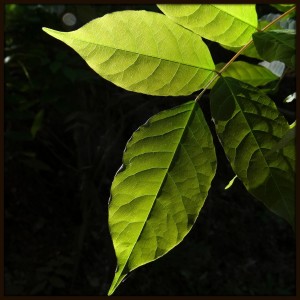
The wisteria blooms are all spent now, save for a few shriveled flower petals that haven’t yet fallen onto the roadway.  Yet, for all its aggressiveness, Chinese wisteria also offers moments of dazzling beauty.  Even after the flowers are gone, the leaves still captivate me, illuminated by late afternoon light.  They glow like the finest stained glass, turning a rural lane into a chapel for contemplating the cosmos.

Illuminated

Apr 222014
 

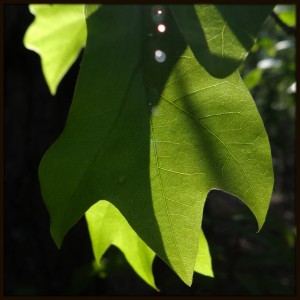
I set out down Piney Woods Church Road this morning still carrying the heavy burden of the recent news of a much-loved local store’s plans to close in May.  Although clouds and storms are expected this afternoon, the morning sky was mostly clear and the sun angling its light through the trees.  Again I was drawn to explore the possibilities of the morning light, this time bathing tulip poplar leaves.  I think it would be fitting to refer to these moments of wonder that I find with my camera lens as moments of grace.  I am gratefull that a digital camera enables me to share these moments with others.

Moments of Grace


Apr 212014
 

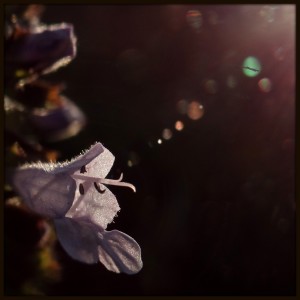
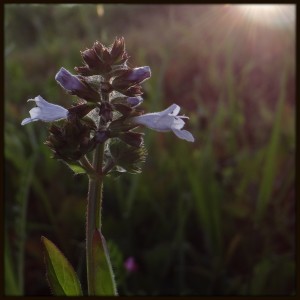
I was feeling bereft today, walking down Piney Woods Church Road, still digesting the sad and unexpected news that my favorite local hangout, a charming old-time general store, will be closing next month.  For most of my walk, wherever I glanced, the magic seemed drained from the landscape.  The wisteria blooms had withered, and all the giant red thistles, just beginning to blossom, had been uprooted by a landowner (understandably — it is a pernicious weed) along the roadside.  Some of my favorite haunts to look for wildflowers had been mowed in the last day or two.  I wondered if I would find anything inviting.  That is when I saw the blooming heal-all (Prunella vulgaris), a common introduced lawn weed throughout North America.  The late-day sun, low on the horizon, offered intriguing photographic possibilities.  The result, after a few minutes of exploration, is this sunlight striking a heal-all flower.  There is a radiance in this image that gives me cause for hope, at such a dark time.  There is solace to be found in nature, if we pause long enough to let it find us.

Healing Light

Addendum, May 22, 2014:  Here is another photograph of the self-heal from the same day’s images. I like it so much that I recently had it printed and mounted on bamboo by Plywerk, Inc. of Portland, Oregon.

Self-Heal

Apr 202014
 

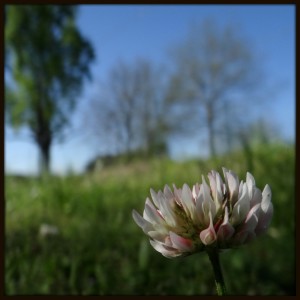
For several days, I have been trying, without success, to capture an interesting image of the white clover (Trifolium repens) now blooming along the edge of a field along Piney Woods Church Road.  Introduced from Europe, this member of the pea family is now common across North America.  So easily overlooked, in this photo white clover shines as the star of the rural landscape.

Field Clover

Apr 202014
 

Take some children on a nature outing this Earth Day!You know that environmentalism has become trendy when “green” starts being used as a verb. Green is the color that the pigment chlorophyll imparts to plant leaves, enabling them to make their own food through an almost magical synergy of air, water, and sunlight.  As such, it evokes the presence of living things, of nature all around us.  It is not a verb that refers to switching one kind of light bulb for another one, or wrapping the hot water heater.

This is not to say that those actions are not beneficial, or important.  Conserving energy by turning down the thermostat or using compact fluorescent light bulbs will not only save money, it will also reduce the burning of fossil fuels that in turn produce greenhouse gases, smog, and even acid rain.  These are important actions in our capacity as environmental stewards, a role we acknowledge and celebrate every year on Earth Day. But just as “green” has its origins in nature, so too does caring for the Earth begin with being in nature. 

Fairs, contests, and appearances by Captain Planet are common ways to commemorate Earth Day.  These events and activities raise human awareness about environmental challenges and how each of us might address them by recycling more and driving less.  But to connect with the heart of what Earth Day is about — the quest to build a long-term, sustainable relationship between human beings and the natural world — the best way to celebrate it is also the simplest.  Provide a child that you know with the opportunity to spend some unstructured time in nature.

Children are the future caretakers of the natural world.  And now, more than ever before, children are not getting the opportunities they need to bond with nature — opportunities that some researchers suspect may be crucial for healthy child development.  They are growing up in sterile suburban developments where doctrines and covenants forbid tree forts and sometimes even look askance at a few branches strewn about the yard.  And they are living highly programmed lives, punctuated by sport practices and away games, music and ballet lessons.  There is so little time and so little opportunity to do what comes naturally to every child — to romp in the woods.

So take your young son or daughter or nephew or niece and lead them on a nature outing.  The children you know will probably will go eagerly, though they may try to bring along a computerized gadget of some sort, depending upon their age and access to those things.  (Resist all such requests.)   For your own part, don’t bring along with you any agendas or lesson plans.  Maybe show the child a place you visited often when you were a child, or just go looking for an oak tree to climb or a stream to follow.  Let the child be Explorer Number One (as this author once referred to himself on outings with his dad, Explorer Number Two).  Have adventures together.  Splash in a stream, turn over rocks, and then return home late for dinner, muddy and scratched.

It will be the most exhilarating, joyful, and beneficial Earth Day you can ever have — at least, until next year.

This article was originally published on April 21, 2010. 
Apr 202014
 

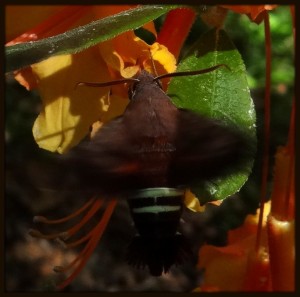
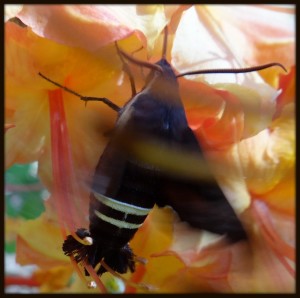
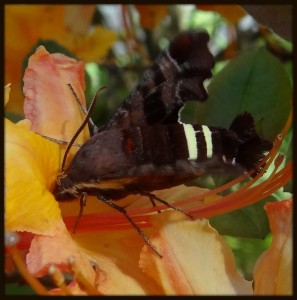
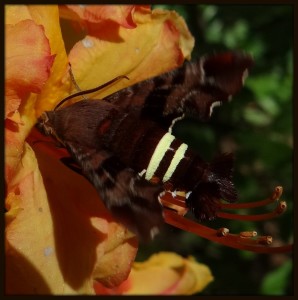
On my way back down Piney Woods Church Road toward home today, I stopped to visit with a neighbor and dear friend.  He showed me his native azalea, in full bloom along the side of his house.  As we stood there admiring its showy, brilliant orange blossoms and delicate, honeysuckle-like scent, a large moth appeared.  I had never seen its kind before; it had brilliant black and yellow banding on its abdomen.  Several field guides and a Google search later, I determined that it was a Nessus Sphinx moth (Amphion floridensis).  Common throughout the eastern United States, this moth is fairly unusual for being active during the daylight hours, feeding on the nectar of various plants.  The caterpillar larva’s host plants include amplelopsis, cayenne pepper, and grapevines.  Considering the local habitat offerings, I suspect that it fed on wild grape leaves.

1-DSC09294

1-DSC09297

1-DSC09298-001

1-DSC09299

Apr 192014
 

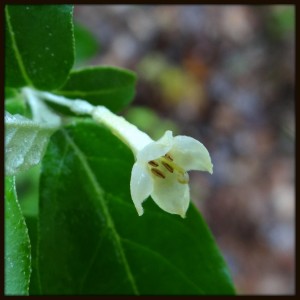
At last, after numerous attempts and almost as an afterthought, I managed to capture a privet blossom today along Piney Woods Church Road.  The flowers are simple yet almost elegant.  Like wisteria, I think they are more attractive solitary than in the clusters where they are typically found (in the case of privet, perhaps four or five blooms all crammed together on a stem).  Perhaps that is because both plants are so highly invasive.  All the privet flowers (happily visited by buzzing bumblebees on sunny days) will become privet seeds, and  privet’s conquest of the Georgia Piedmont will continue.

1-DSC09180

Apr 192014
 

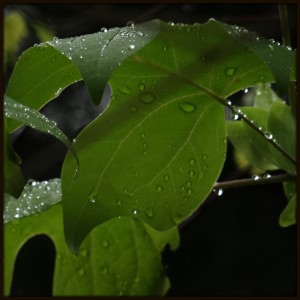
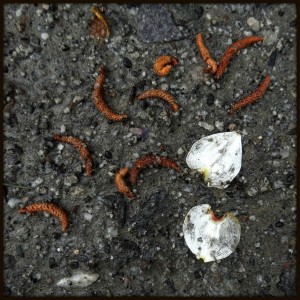
A moderate breeze was blowing through the tulip poplar saplings on the morning after a long rainfall.  I took this picture while the leaves swayed in the wind, water droplets clinging to their stems and upper surfaces.  As proof that yesterday’s rain was quite intense, I include the bottom photograph:  evidence that it did, in fact, rain dogwoods and catkins.

1-DSC09157-001

1-DSC09182

Apr 192014
 

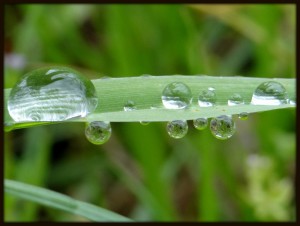
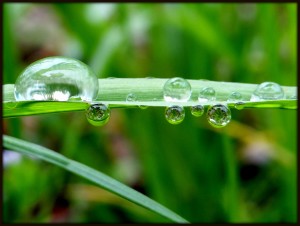
I was drawn to take this photograph by the line of tiny water droplets, like miniature glass marbles, cradled atop a blade of grass.  While taking the photograph, I noticed that there also seemed to be water droplets along the underside of the grass blade.  At home, viewing the image in Picassa, I was surprised to see these globes of water hanging so delicately, like suspended worlds.  I included two near-identical pictures below because the second one includes an image of the photographer (the first one includes part of the photographer’s hand, but not his distinctive hat).  Can you spot this unintended “selfie”?

1-DSC09190


1-DSC09193