Feb 112014
 

While sitting at the keyboard monitoring the approaching ice storm on Weather.com radar every five minutes or so, I thought I might post another abstract photograph, this time one from earlier today.  I took this shot looking into the woods near Rico Road.  Using the telephoto zoom and focusing on a nearer object, I managed to bring the rest of the image out of focus.  Keeping my finger halfway down on the exposure button and then moving my camera enabled me to circumvent the auto-focus feature and produce a few intriguing abstract images.  How I ended up with these colors (with minimal post-processing on my part) by shooting a photo looking into a gray-brown forest in winter is not entirely clear.

Into the Woods

Feb 112014
 

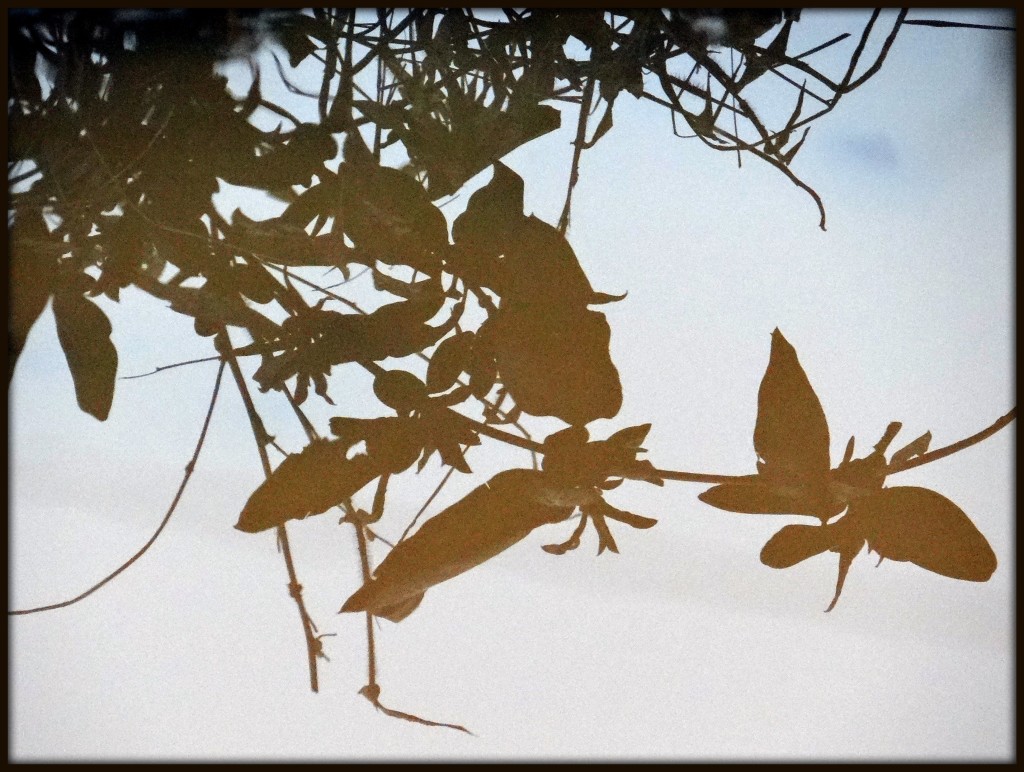
It was a gray, raw day along Piney Woods Church Road, on the afternoon before a storm named Pax (ironically) is slated to hit the Atlanta area with perhaps half an inch of icing and then an inch or two of sleet or snow.  An earlier spell of light rain left a few water droplets scattered on the branches of shrubs and vines.  I took quite a few photographs on my way toward Hutcheson Ferry Road, some abstracts and others close-ups of multi-colored water oak leaves, gray-green lichens, and rusty-orange fungi.   On my way home, I stopped to glance at the ruts near the intersection with Rico Rd.  A leafy vine growing next to the rut was reflected in the silt-laden water.  The result is evocative of Japanese art — a visual haiku lying in a muddy rut on a gravel road in Chattahoochee Hills, Georgia.

Upon Further Reflection

Feb 102014
 

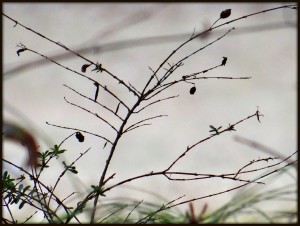
A few abstract images gleaned from today’s Piney Woods Church walk.  I am enjoying the possibilities of the blur.  I have opted for spare titles to accompany them.  From top to bottom: Winter Shrub; Robin in the Lawn; Distant Leaf; Budding Tree; and Loblolly Pine.

Winter Shrub

Robin in the Lawn

Distant Leaf

Tree in Bud

Loblolly Pine

Feb 102014
 

Late afternoon today was truly overcast, with a gloom betokening approaching winter weather.  Rain tomorrow, freezing rain on Wednesday.  I spent most of my hour along Piney Woods Church Road looking for splashes of color to photograph, doing a lot of experimental out-of-focus work (Is it possible to be focused on not focusing?).  I took several images reminiscent of abstract watercolors, which may find their way into a separate post.  At the end of my time in the field, on the way back to Rico Road, I took several photographs of red-winged blackbirds silhouetted in the bare upper branches of a distant tree.  To try for some telephoto shots without blur, I used a metal fencepost to steady my camera.  I took only one photo, and then the birds were gone.  By sheer luck, I caught this bird with its wings extended, about to launch itself into space.

Blackbird Fly

Feb 092014
 

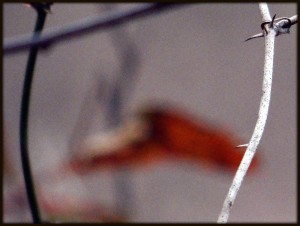
Yesterday evening and earlier today, I spent a couple of hours poring over the work of Kathryn Kolb, a fine art nature photographer living in Atlanta.  She has taken stunning medium-format camera photos of branches and leaves in her backyard, around the city, and across the country.  In her work, there is often no central subject in focus — the entrancement of the image comes from the pattern of forms and the play of light.   Many of them are like impressionistic paintings, venturing below the surface forms to encounter the life energy contained within.  Before I saw her images, I tended to consider pictures with an unfocused subject as mistakes.  Now I know otherwise; blurred images have their own power and allurement.  Today’s offering of a greenbrier leaf from Piney Woods Church Road is in appreciation of Kathryn Kolb.

Red Leaf

Feb 092014
 

The Dandelion (old)There is perhaps no more commonly recognized reminder of spring in a Georgia backyard than the appearance of the first dandelion bloom.  For some, the first common dandelion (Taraxacum officinale) is a bright yellow promise of warm days to come and wildflowers soon to bloom.  For others, it  marks the beginning of another round of the battle between human and weed, waged on lawns across the country.

In its commonness, it is a plant easily ignored by adults.  Children know better.  They pluck bouquets of dandelions to give to parents and friends, not minding temporary skin discoloration from the sticky, milky sap in the flowers’ hollow stems.  Even more enthusiastically, they pluck up the seed heads, blowing them apart and helping to disperse the seeds to a neighbor’s picture-perfect weed-free yard.  This writer recalls doing these things, and especially watching the seed heads parachuting away on a spring breeze, to parts unknown.

In its commonness, it is a reminder of how little we know about, and appreciate, mundane nature — the myriad living things all around us that we take for granted as the years go by.   The dandelion is worth a second look.  There is more going on than meets the eye at a single glance.  Take, for example, the leaves of a dandelion.  They form a basal rosette, a swirl of leaves close to the ground.  Each leaf has a central vein with a groove down the center, and when it rains, this groove channels the rainfall directly to the center of the plant.  Besides appreciating the leaves for their structure, one can also appreciate their edibility.  They make a tasty addition to salads, while being higher in Vitamin A than carrots, and also containing large amounts of Vitamin C, potassium, iron, and calcium.

The dandelion also possesses an impressive taproot, reaching into the ground a foot or more.  In some plants, the taproot may constitute as much as half of the plant by mass.  Roasted, the root provides a coffee-substitute with a number of purported health benefits.  The root also offers an excellent upper-arm workout for weeders.

Finally, there is the dandelion bloom itself, with its complex life-cycle.  The flower head contains  up to 200 tiny overlapping flowers.  Their pollen attracts hungry ladybugs, serving to reduce the number of aphids that would otherwise feed on garden plants.  The flowerheads open at about nine in the morning, and close again in the afternoon, lasting only about a day.  Then they seal tight for a couple of days, undergoing a botanical metamorphosis, like a caterpillar in a chrysalis.  During this time, the stalk elongates, lifting the flower higher into the air.  Finally the head opens again, revealing a “fairy clock”, a globe of barbed seeds with downy parachutes.   In time, those seeds are carried away in the wind, or rising convection currents, or the gentle breath of a child.

This article was originally published on March 28, 2010. 
Feb 082014
 

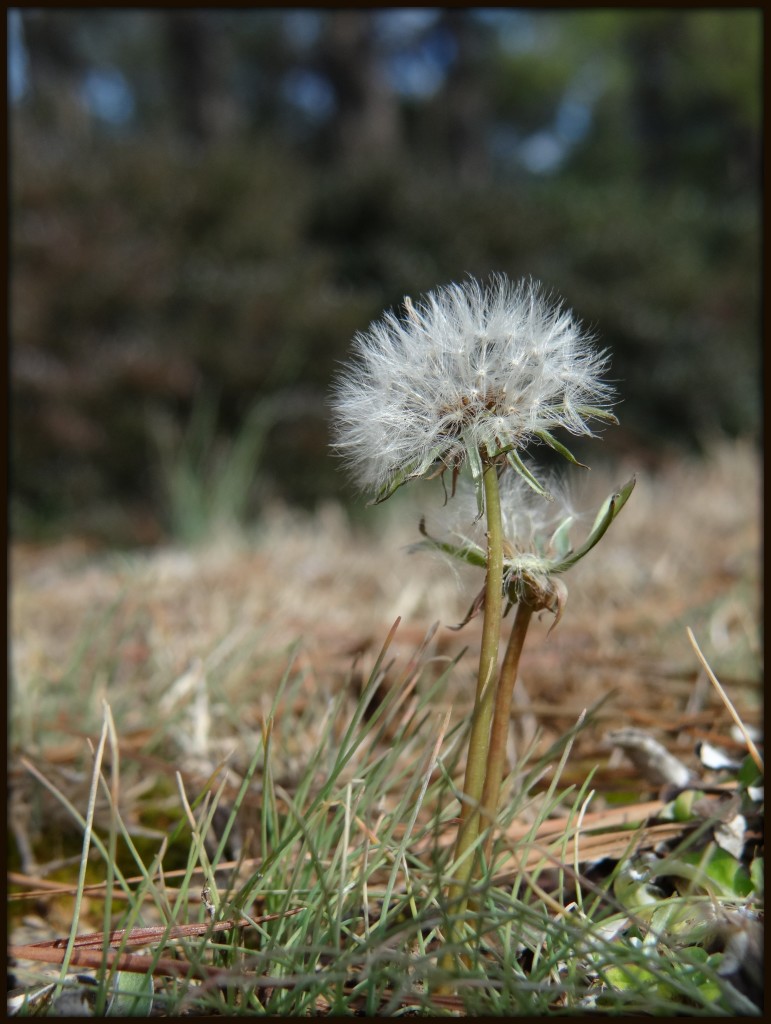
A few days ago, I began adding to my Piney Woods Church Road walk a few furtive glances for signs of spring.  I have been watching, in particular, for daffodils to emerge from the soil — there are quite a few clusters of them growing in and alongside a pasture about halfway on my walk.  Alas, no luck yet.  Imagine my surprise today when I discovered a dandelion — not a budding flower stalk, or even an open flower, but a seed head, waiting for the wind.  It is a marvelous reminder of all that I have missed this year.  Somehow, the flower stalk emerged and bloomed and produced seeds during January and early February, all without my noticing.  But today I paused to take this photograph.  After snapping half a dozen shots, as I was about to stop and be on my way home, the sun emerged from a cloud.  A lovely moment on a Saturday afternoon in not-yet-springtime.

Dandelion

Feb 072014
 

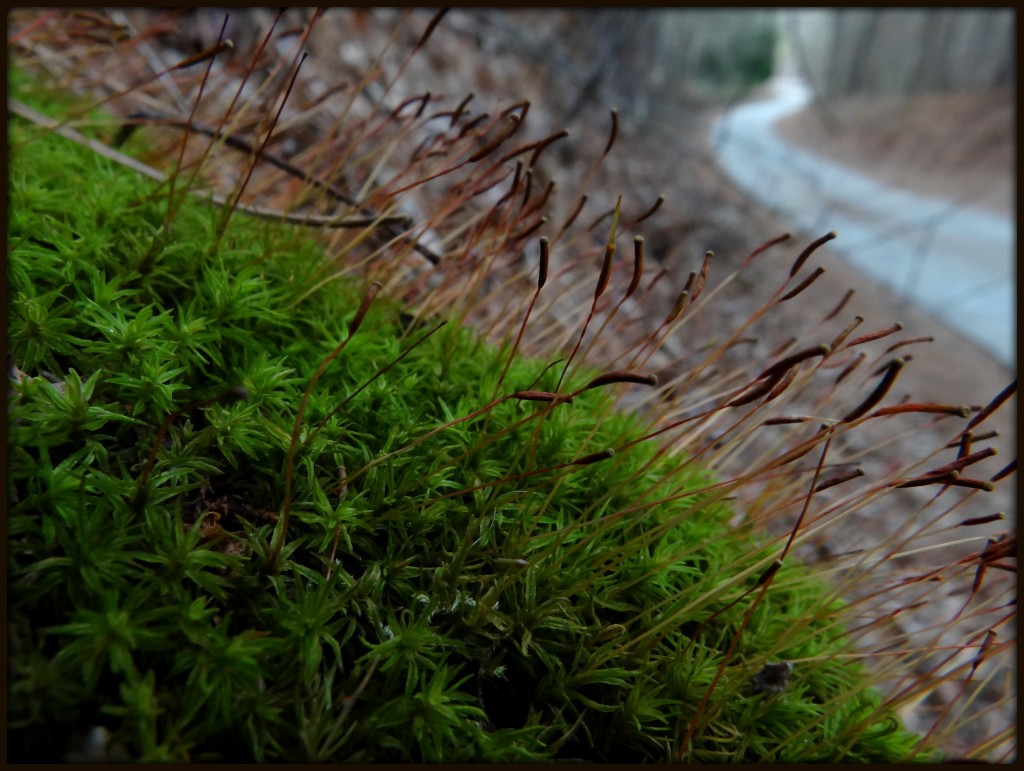
Yet another of this year’s mostly cloudy and chilly afternoons found me along Piney Woods Church Road, scrambling for an image to share for today.  I explored a few new possibilities that might lead to photographs, including an almost-Southwestern miniature erosion landscape with lichens.  But for the most part, the muse eluded me.  Fortunately, I had begun my outing — like so many before this one — taking a few photographs of a mossy spot along the  wooded part of the road, looking back toward the junction with Rico Road.  I tried to investigate what species of moss this is, but I turned up lots of photographs of Spanish Moss and Elisabeth Moss instead.  And I learned from a listserv on bryophytes (mosses and their kin) that a field guide to Georgia mosses is well overdue (if anyone out there is interested in a topic for their next book).  Short of a name for this moss, I can at least identify the stalks scattered among the green leaves as sporophytes, and the capsules atop the stalks (containing the spores for the next gametophyte generation) as sporangia.  The complete life cycle of mosses is depicted here.

Mossy Bank

Feb 062014
 

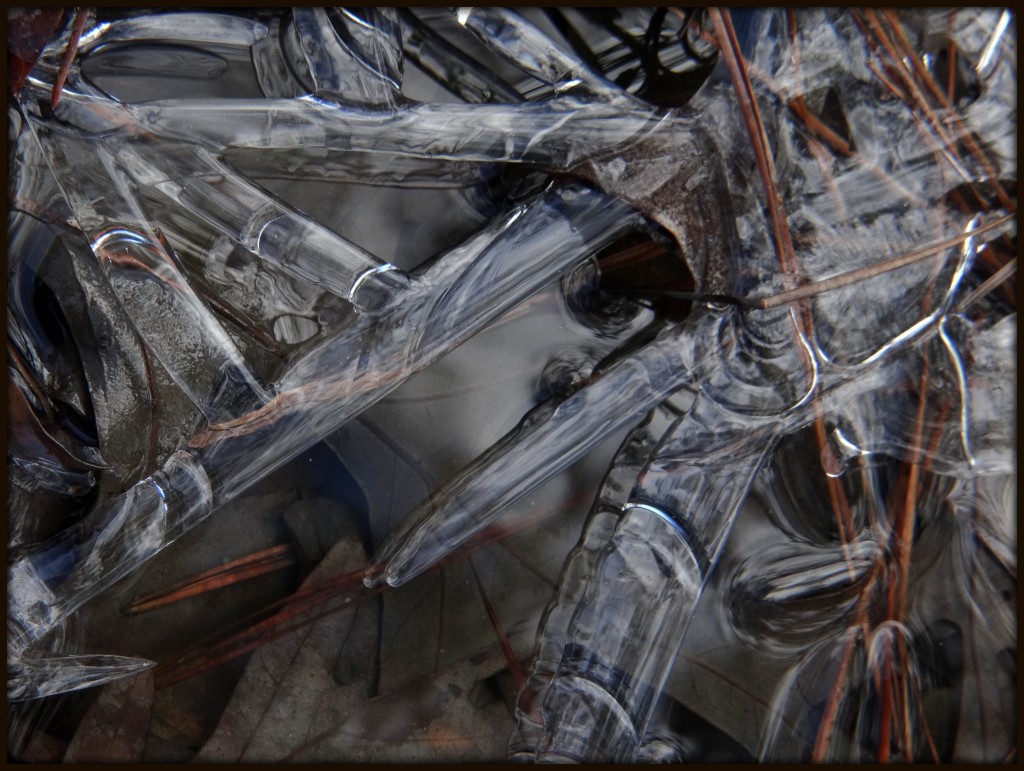
I returned this morning to the same spot along the side of Piney Woods Church Road where I saw the oak leaf floating yesterday, and discovered needles of ice had formed overnight.  Every moment, the world around us is changing.  In the spirit of Heraclitus, we can never step onto the same road twice.

Morning Ice

Feb 052014
 

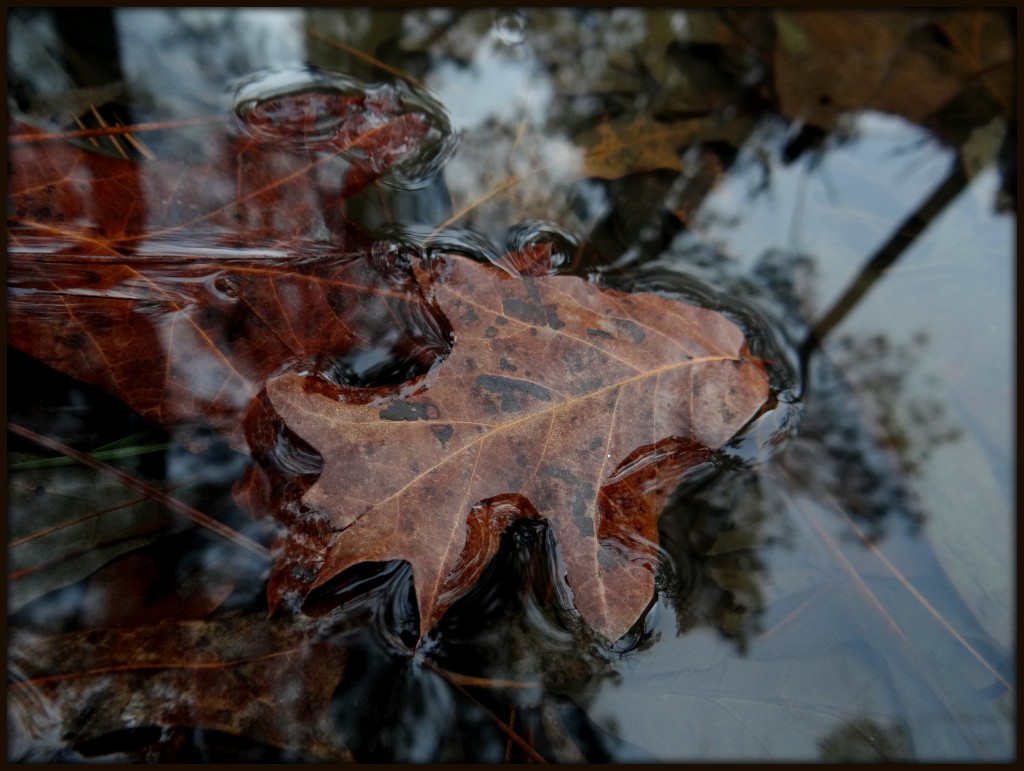
After the overnight rainstorm, the ditches along Piney Woods Church Road had filled with water once again.  In one of them, I saw this oak leaf floating, the edges of the leaf slowly taking on water.   The stillness of the scene offers no hint of the raw winter’s day on which I took this photograph.

After the Storm