Jan 142014
 

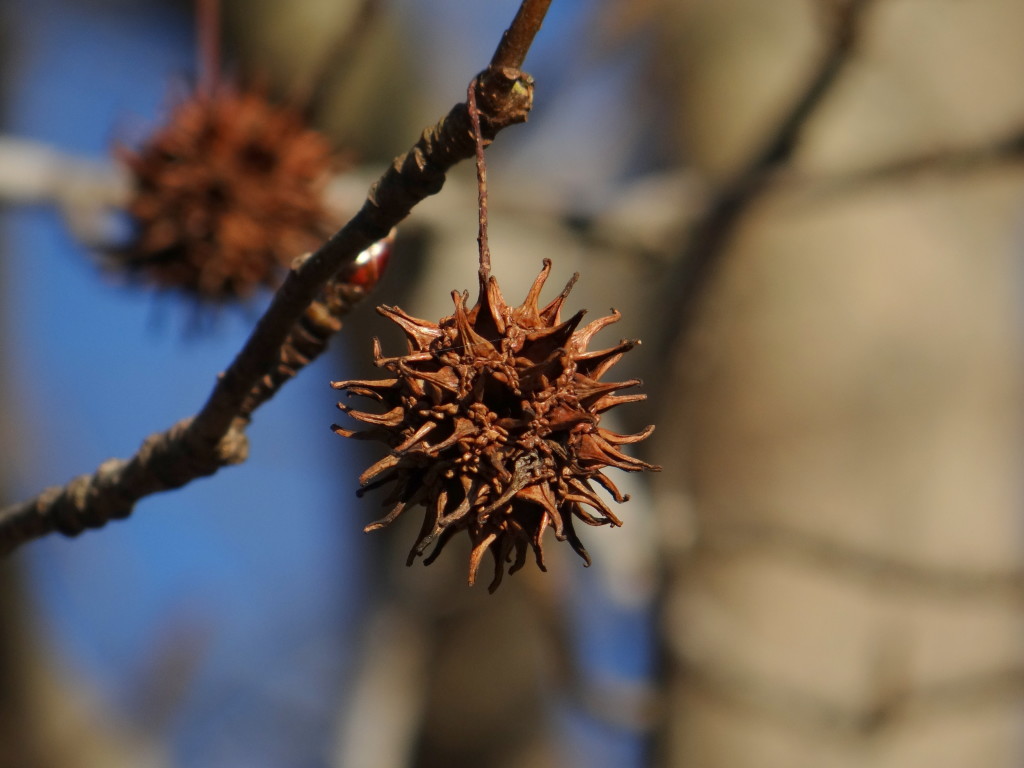
After a light rain yesterday evening, today was a clear-blue sky day.  I set off late in the afternoon to see what I might discover along Piney Woods Church Road.  I took quite a few stand-by photographs, and also found an unopened cocoon — probably belonging to a saturniid moth — suspended from the top of a winter weed.  While intriguing from a natural history perspective, the cocoon simply would not yield a good photo.  Indeed, it was a day of many shots coming close, but not quite working out.  As usual, the principle of taking lots of images and trusting the odds came to my rescue.  Near Rico Road, I photographed a sweetgum seed pod hanging from its stem about ten feet above the ground.  Since it was well out of my reach, I photographed it with my zoom lens, not the macro +4 I have been using of late.  I love the deep blue sky in this photo.

Sweetgum Ornament

Jan 132014
 

On a warmish and grayish morning, I set out to see what I could find happening along Piney Woods Church Road.  I re-took several photographs whose images will likely appear in this blog sometime this year — resurrection ferns, lichens, and an endless array of leaves, vines, and stalks of winter weeds.  I photographed the ripple marks in the rut at the end of the road again — the water has mostly dried up, although additional rain is expected overnight.  In the end, though, I did not choose any of those subjects for today.  Instead, I offer this white cow in a field most of the way toward Rico Road.  It lounged in the field like a cow sculpture, not even moving (or blinking, as far as I could see) while I wandered by and snapped several photos.  What was it thinking as it gazed at me?

The Thinker

Jan 122014
 

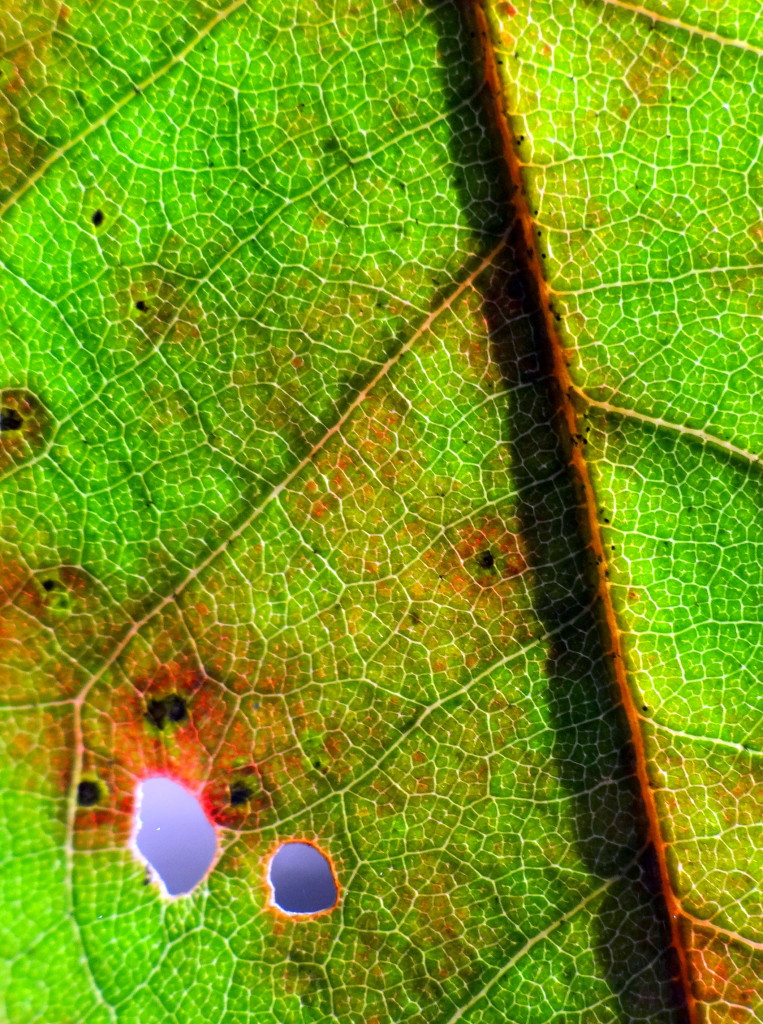
Bright mid-morning sunshine greeted my arrival at Piney Woods Church Road today.  The road was no longer covered with flowing water, and yesterday’s water droplets were gone.  Still, I found plenty to photograph, including various vines, resurrection ferns, and reflections in the water remaining in roadside ditches.  Toward the end of my walk, a persimmon leaf, still attached to a sapling and still mostly dark green, beckoned me.  I took out my +10 macro lens — one that actually has to be pressed into the subject of the image in order to achieve focus — and took several images of the leaf.  The result is this leafscape, vibrant with color in the midst of a drab Georgia winter.

Persimmon Leafscape

Jan 122014
 

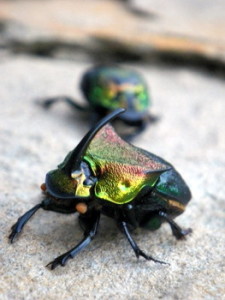
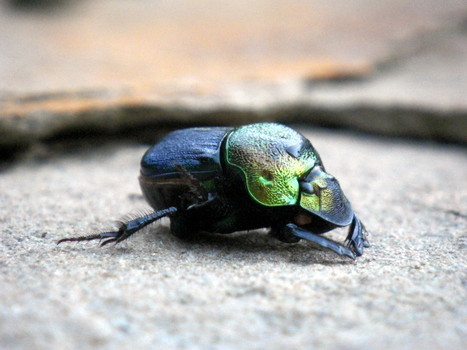
Dung BeetleDung Beetle 2


One year ago, scientists announced their discovery of the first animal ever observed using the light of the Milky Way galaxy as an aid to navigation.  This same organism also uses the Sun and Moon to guide it on its journey.  The animal in question is not a mammal or a bird, but a lowly dung beetle, an insect which (as its name suggests) feeds on excrement, and spends much of its life preparing balls of excrement to feed its young after they have hatched.  While scientists do not believe that their eyes can detect individual stars, the beetles can perceive the gradient of light that our home galaxy traces across the night sky.  As it rolls its ball of dung away from the source, the dung beetle will stop and climb to the top of the ball, in order to determine which way to go.  This insures that the dung beetle will continue to move away from the original excrement source, rather than risk running into other dung beetles all clamoring for their share of the prize.

This is an article in praise of dung beetles.  Often overlooked, maligned, and even ridiculed, these beetles have, for millions of years, quietly roamed the Earth (and burrowed into it), feeding on animal waste and using it to rear their young.  In doing so, they help to clean up the environment and reduce the risk of disease.  Not only is dung beetle behavior fascinating (many males will use horns on their head to spar with each other over females, for instance), but many dung beetles are quite beautiful, as well.

One of the most common, and intriguing, of the New World dung beetles is the rainbow scarab beetle, Phanaeus vindex, shown in the accompanying photos.  About the size of a dime, this beetle is common across much of the country, from Arizona to Florida and north to Michigan and Vermont.  Few people here in the US raise them for a hobby (which is true of beetles in general), although this author is thinking about doing so.  Obviously, there are obstacles, but not enough to prevent the serious beetle enthusiast from having a go at it.  As the foremost expert on beetle husbandry, Orin McMonigle, remarks in his magnum opus, The Ultimate Guide to Breeding Beetles, “The idea of handling dung does not appeal to everyone.”  But “when a person moves past the dung aversion, these beetles prove very interesting.”  In fact, they can be “curious, active, and comical captives.”

Dung beetles are perhaps the most historic of all insects.  Revered more than four thousand years ago by the ancient Egyptians as a symbol of eternal life, scarabs (as dung beetles are also called) are commonly depicted in their paintings, statues, and jewelry.   Dung beetles have a four-part life cycle, passing from egg to larva to pupa to adult.  During the pupa stage, the beetles appear mummy-like; emerging from the pupa, the adults rise up out of the ground to begin the search for dung.  It is likely that dung beetle pupae inspired the Egyptians to mummify their dead, while the adult beetles’ emergence into daylight evokes the mythological emergence of the dead into the afterlife.

Phanaeus vindex has, too, carries traces of ancient history.  The genus Phanaeus, meaning “bringing light”, was named after the sun god of the ancient Greeks.  The species name, vindex, is Latin, and means “protector”, perhaps because the rainbow scarab performs the necessary function of cleaning up dung, or maybe because of the male beetle’s prominent curved horn.  Males come in two types – a characteristic called allometry.  Some have long horns, and others have much shorter ones.  When the beetle larvae have access to plenty of nutrients, they develop long horns; when nutrients are scarcer, they develop shorter ones.   The longer-horned ones wind up battling each other for mates.  The shorter-horned ones don’t always lose out, though.  They tend to develop faster and emerge earlier from the ground, so they sometimes get to the females first.  If that fails, they rely on stealth – trying to sneak past two males with locked horns to reach the waiting female.

The life of a Phanaeus vindex centers on the quest for excrement.  The beetles are equipped with highly sensitive antennae that enable them to locate the freshest, most nutrient-rich dung possible.  Some will even perch on a plant branch, antennae at the alert, waiting to detect the scent of newly-deposited dung wafting in the breeze.  After locating a promising source, rainbow scarabs will begin constructing tunnels in which to deposit their find, and where the females will subsequently lay their eggs.  (After the eggs hatch, the larvae will remain underground, feeding on the dung, until they pupate, turn into adults, and emerge to start the excrement search again.)  In the wild, male and female dung beetles have been observed working together to construct nesting tunnels.  Strangely enough, once placed together in captivity, a male and female pair of beetles will ignore each other, and the female will do all of the nest-building work.

Yet another unusual quality of Phanaeus vindex is that the beetles are vibrotaxic.  This means that that they can detect, and respond to, vibrations in their environment.  A rhythmic tapping on the side of a beetle enclosure will cause its occupants to move in unison with the beat.  Stop tapping, and the beetles stop moving, like children playing “Red Light / Green Light.”  Scientists theorize that this behavior helps the beetles avoid predators, such as lizards, mice, and birds.

Dung beetles have fascinating behaviors and sport eye-catching metallic colors.  Ultimately, however, dung beetles are worthy of merit simply because all living things are.  All organisms on Earth participate in a complex web of ecological relationships of which we, too, are a part.  As Arthur Evans and Charles Bellamy explain at the close of their book, An Inordinate Fondness for Beetles, “…beetles play a significant part of a seasonal exchange between earth and sky, a pulse in the cycle of life.  Each beetle is but part of a population and embodies the sum total of its evolutionary history and potential.  Each population interacts with the others, including our own, and with the soil and atmosphere in a multiplicity of interrelationships that melt seamlessly into one another.  We can take solace in beetlephilia.”

This article was originally published on February 18, 2013.  Both photographs are copyright Valerie Hayes. 
Jan 112014
 

Eleven days into my Piney Woods Church Road project, and already I feel compelled to break my self-imposed rule of only posting one photo per day.  I find this image so haunting and disturbing that I feel compelled to share it, yet I find it too dark for my 365 project.  What makes this picture so troubling?  It is only a shriveled oak leaf, somehow caught up in the tendril of a greenbrier.  Or is it?

Strange Leaf

Jan 112014
 

The tumultuous thunderstorm of early morning had passed, and the fog was lifting.  I arrived at Piney Woods Church Road to discover, quite literally, a river running through it — flowing down the roadway and into the very same ruts that had been covered in ice just a few days before (see Day Seven).  Now, the rut held a lovely pattern of ripple marks, sedimentary structures formed by the action of water flowing across the silt of the roadbed.  I tried to take a photo of the ripple marks without any reflections present, mostly for my own appreciation as a geologist.  But each time I attempted to do so, I ended up in the photograph, regardless of which side of the rut I stood, or how wet my feet became in the process.  Ironically, the result was this delightful self-portrait.

Stuck in a Rut

Jan 102014
 

As my project duration moves into the double digits (365 definitely feels like a long way off!), clouds have returned to the Georgia Piedmont.  On a highly humid day (near one hundred percent), I ventured to Piney Woods Church Road in the early afternoon, in search of fog.  There were light patches that helped soften the background landscape a bit, but nothing particularly enticing to photograph.  Instead, though, I quickly discovered the potential of photographing water droplets suspended from the tips of leaves and branches.  Using my plus four macro lens, I took dozens of droplet photos as I walked toward Hutcheson Ferry Road and back.    My first — and last — photographs were taken of droplets on the leaves of cedar trees growing along the edge of a property bordering the road at its intersection with Rico Road.   Facing the intersection, I framed my photos to include the brilliant red of the stop sign,  out of focus in the background.  Returning along Piney Woods Church Road, I wondered if it might be possible to take the same photograph, but include a vehicle driving by.  The result (on the second attempt) was the image below.  I have titled it “Stop Action” to reflect the juxtaposition of the car racing by with the “frozen in time” feeling created by the water droplet, with the stop sign adds further to this visual contradiction.  I am tempted to add that this is probably one of my most didactic photos I have taken lately, recommending that we “stop action” from time to time in order to notice the ephemeral and the beautiful all around us.  How often have we allowed ourselves the time after a light rainfall to wander the land, admiring the lingering water droplets that cover pine needles  and honeysuckle vine tendrils like tiny jewels?

Stop Action

Jan 092014
 

By the time I set out on a late afternoon saunter to Piney Woods Church Road, the leaden skies had given way to a fine mist — not quite fog, and not quite a drizzle, but approaching what Thoreau called a “mizzling” rain.  It was certainly not a day for sunset opportunities.  Indeed, it was one of those days that I knew, sooner or later, would happen.  Throughout most of the walk, I was accompanied by a small voice in my head, telling me that I was running out of photograph opportunities, and how silly I must be for thinking that this short gravel road outside Atlanta would somehow yield a trove of images and experiences.  I persevered nonetheless, dutifully photographing a rock with lichens and mosses (not in sharp focus) and a single red greenbriar leaf against a background of tan-brown fallen leaves from last autumn.  I photograph both of these every day now; be watching for when they appear in this blog.  I was tempted to turn back early, satisfied with either the rock or the leaf, but I continued to where Piney Woods Church Road meets Hutcheson Ferry Road.  Standing in a ditch beside the intersection, I took this photograph of moss with clinging water droplets, using my +4 macro lens.  I am reminded, for some reason, of a rolling Irish landscape.  Perhaps because it seems always to be raining in Ireland…..

Moss at the End of the Road


Jan 082014
 

Some of my photographs, such as the ice mural from yesterday, are very much premeditated creations. It was a brutally cold Tuesday afternoon, and I expected to find interesting ice patterns somewhere along Piney Woods Church Road.  Once I saw the marvelous examples of frozen ice bubbles in rut marks, I knew I had my image for the day.  Today’s photograph, on the other hand, was much more serendipitous.  I anticipated a few clouds at sunset, since tomorrow is predicted to be mostly cloudy.  What I did not anticipate (or discover, until I got home and reviewed my photographs) was the image below.  It looks as if the tree branches and clouds are interacting with each other — the tree branches somehow pushing the cloud edges away.

Sunset with Branches and Clouds

Jan 072014
 

Only a couple of days ago, I recall setting off down Piney Woods Church Road, from its intersection with Rico Road, and finding deep muddy ruts along the road edge.  I remember being upset by this disfigurement of my daily journey.  Yet, passing by that same spot today, I discovered the beautiful, intriguing patterns of ice bubbles frozen into those very ruts.  What before was unsightly has now been rendered attractive and photo-worthy.  The result is this “ice mural”, an image which I can imagine painted into the side of a building in some city somewhere.  The abstractions suggest a landscape with figures — but I will leave interpretations to readers.  What do you see in this image?

Ice Mural